


Page 18 - Tafsir of surat at tawba repentance
P. 18
© Islamic Online University Usool at-Tafseer
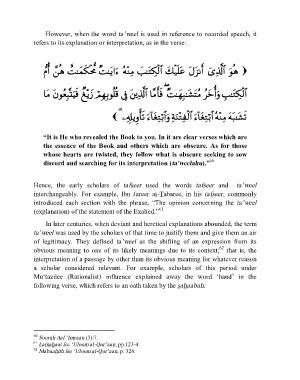
However, when the word ta’weel is used in reference to recorded speech, it
refers to its explanation or interpretation, as in the verse:
Pé& £`èd ìM»yJs3øtC ×M»t#uä çm÷ZÏB |=»tGÅ3ø9$# y7øn=tã tAtRr& üÏ%©!$# uqèd )
$tB tbqãèÎ6®Kusù Ô÷÷y óOÎgÎ/qè=è% Îû tûïÏ%©!$# $¨Br'sù ( ×M»ygÎ7»t±tFãB ãyzé&ur É=»tGÅ3ø9$#
3 3 ( ¾Ï&Î#Írù's? uä!$tóÏGö/$#ur ÏpuZ÷GÏÿø9$# uä!$tóÏGö/$# çm÷ZÏB tmt7»t±s?
“It is He who revealed the Book to you. In it are clear verses which are
the essence of the Book and others which are obscure. As for those
whose hearts are twisted, they follow what is obscure seeking to sow
60
discord and searching for its interpretation (ta’weelahu).”
Hence, the early scholars of tafseer used the words tafseer and ta’weel
interchangeably. For example, Ibn Jareer at-Tabaree, in his tafseer, commonly
introduced each section with the phrase, “The opinion concerning the ta’weel
61
(explanation) of the statement of the Exalted.”
In later centuries, when deviant and heretical explanations abounded, the term
ta’weel was used by the scholars of that time to justify them and give them an air
of legitimacy. They defined ta’weel as the shifting of an expression from its
obvious meaning to one of its likely meanings due to its context; 62 that is, the
interpretation of a passage by other than its obvious meaning for whatever reason
a scholar considered relevant. For example, scholars of this period under
Mu‘tazilee (Rationalist) influence explained away the word ‘hand’ in the
following verse, which refers to an oath taken by the sahaabah:
60
Soorah Aal ‘Imraan (3):7.
61
Lamahaat fee ‘Uloom al-Qur’aan, pp.123-4.
62
Mabaahith fee ‘Uloom al-Qur’aan, p. 326.
http://www.islamiconlineuniversity.com 18

