


Page 14 - Tafsir of surat at tawba repentance
P. 14
© Islamic Online University Usool at-Tafseer
history, authored al-Jawaahir al-Hisaan fee Tafseer al-Qur’aan, in which he
45
gathered all of the narrations about the ancients, regardless of their authenticity.
Tafseers of this era and subsequent generations contained a mixture of truth
and falsehood, some valuable material and much that was worthless. Eventually,
tafseer based on personal opinions completely superseded tafseer based on
authentic narration. The authors of these tafseers stretched the meanings of the
verses to affirm the thoughts and ideas of their respective sects or schools and
rebut those of others. Thus, the primary role of tafseer, that of explaining religious
instruction contained in the verses, was lost. The tafseer scholar Jalaalud-Deen
as-Suyootee (d. 1505 CE/910 AH) noted the following:
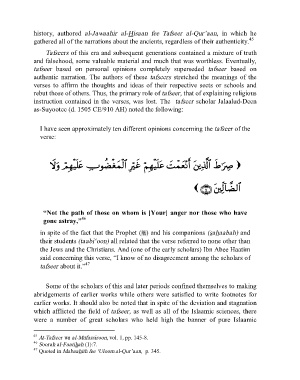
I have seen approximately ten different opinions concerning the tafseer of the
verse:
wur óOÎgøn=tæ ÅUqàÒøóyJø9$# Îöxî öNÎgøn=tã |MôJyè÷Rr& tûïÏ%©!$# xÞºuÅÀ )
( ÇÐÈ tûüÏj9!$Ò9$#
“Not the path of those on whom is [Your] anger nor those who have
46
gone astray,”
in spite of the fact that the Prophet (r) and his companions (sahaabah) and
their students (taabi‘oon) all related that the verse referred to none other than
the Jews and the Christians. And (one of the early scholars) Ibn Abee Haatim
said concerning this verse, “I know of no disagreement among the scholars of
47
tafseer about it.”
Some of the scholars of this and later periods confined themselves to making
abridgements of earlier works while others were satisfied to write footnotes for
earlier works. It should also be noted that in spite of the deviation and stagnation
which afflicted the field of tafseer, as well as all of the Islaamic sciences, there
were a number of great scholars who held high the banner of pure Islaamic
45
At-Tafseer wa al-Mufassiroon, vol. 1, pp. 145-8.
46
Soorah al-Faatihah (1):7.
47
Quoted in Mabaahith fee ‘Uloom al-Qur’aan, p. 345.
http://www.islamiconlineuniversity.com 14

