


Page 16 - Tafsir of surat at tawba repentance
P. 16
© Islamic Online University Usool at-Tafseer
neglect of other aspects of tawheed and of the dangers posed by forms of shirk
other than shirk in legislation. He seems to have actually been confused about the
difference between tawheed al-ulooheeyah and tawheed ar-ruboobeeyah. 53 His
critics also say that he laid the seeds for today’s modern takfeer movements with
his blanket condemnation of contemporary Islaamic societies as having nothing to
do with Islaam, and with his praise of revolutionary movements in Islaamic
54
history. Despite these shortcomings, he presented a vigorous Islaamic critique of
the flaws of secularism and the European civilization that spawned it at a time
when most Muslims were apologetic about Islaam.
Tafseer and Ta’weel
The words tafseer and ta’weel were considered synonyms by the early
generations of Muslims; however, in the centuries following the era of the
taabi‘oon and their students (9th and 10th centuries CE/3rd and 4th centuries
AH), the term ta’weel took on a new meaning with new and dangerous
implications. Consequently, it is necessary for us to look at these terms in their
original context, as well as their later usage.
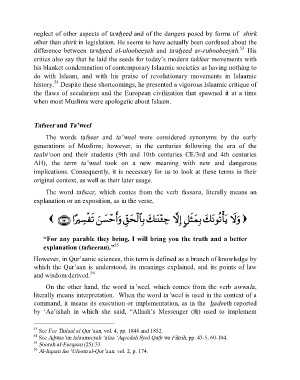
The word tafseer, which comes from the verb fassara, literally means an
explanation or an exposition, as in the verse,
( ÇÌÌÈ #·Å¡øÿs? z`|¡ômr&ur Èd,ysø9$$Î/ y7»oY÷¥Å_ wÎ) @@sVyJÎ/ y7tRqè?ù't wur )
“For any parable they bring, I will bring you the truth and a better
55
explanation (tafseeran).”
However, in Qur’aanic sciences, this term is defined as a branch of knowledge by
which the Qur’aan is understood, its meanings explained, and its points of law
56
and wisdom derived.
On the other hand, the word ta’weel, which comes from the verb awwala,
literally means interpretation. When the word ta’weel is used in the context of a
command, it means its execution or implementation, as in the hadeeth reported
by ‘Aa’ishah in which she said, “Allaah’s Messenger (r) used to implement
53
See Fee Thilaal al Qur’aan, vol. 4, pp. 1846 and 1852.
54
See Adwaa’un Islaameeyah ‘alaa ‘Aqeedah Syed Qutb wa Fikrih, pp. 43-5, 60-104.
55
Soorah al-Furqaan (25):33.
56
Al-Itqaan fee ‘Uloom al-Qur’aan, vol. 2, p. 174.
http://www.islamiconlineuniversity.com 16

