


Page 233 - Tafsir of surat at tawba repentance
P. 233
© Islamic Online University Usool at-Tafseer
One of the main methods of this movement is that a position on a given issue
is taken, then evidence is sought to support it. One of their favorite tactics is to
argue on the basis of a particular verse on an issue, often according to their own
new interpretation, while ignoring other verses which make their interpretation
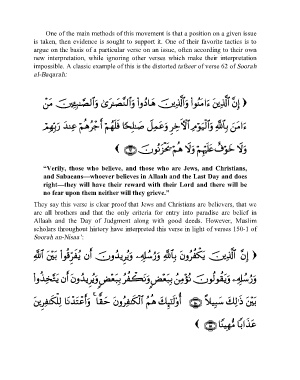
impossible. A classic example of this is the distorted tafseer of verse 62 of Soorah
al-Baqarah:
ô`tB úüÏ«Î7»¢Á9$#ur 3t»|Á¨Z9$#ur (#rß$yd úïÏ%©!$#ur (#qãYtB#uä tûïÏ%©!$# ¨bÎ) )
óOÎgÎn/u yYÏã öNèdãô_r& öNßgn=sù $[sÎ=»|¹ @ÏJtãur ÌÅzFy$# ÏQöquø9$#ur «!$$Î/ z`tB#uä
( ÇÏËÈ cqçRtøts öNèd wur öNÍkön=tæ ì$öqyz wur
“Verily, those who believe, and those who are Jews, and Christians,
and Sabaeans—whoever believes in Allaah and the Last Day and does
right—they will have their reward with their Lord and there will be
no fear upon them neither will they grieve.”
They say this verse is clear proof that Jews and Christians are believers, that we
are all brothers and that the only criteria for entry into paradise are belief in
Allaah and the Day of Judgment along with good deeds. However, Muslim
scholars throughout history have interpreted this verse in light of verses 150-1 of
Soorah an-Nisaa’:
«!$# tû÷üt/ (#qè%Ìhxÿã br& crßÌãur ¾Ï&Î#ßâur «!$$Î/ tbrãàÿõ3t úïÏ%©!$# ¨bÎ) )
(#räÏGt br& tbrßÌãur <Ù÷èt7Î/ ãàÿò6tRur <Ù÷èt7Î/ ß`ÏB÷sçR cqä9qà)tur ¾Ï&Î#ßâur
tûïÌÏÿ»s3ù=Ï9 $tRôtFôãr&ur 4 $y)ym tbrãÏÿ»s3ø9$# ãNèd y7Í´¯»s9'ré& ÇÊÎÉÈ ¸xÎ6y y7Ï9ºs tû÷üt/
( ÇÊÎÊÈ $YYÎgB $\/#xtã
http://www.islamiconlineuniversity.com 56

