


Page 229 - Tafsir of surat at tawba repentance
P. 229
© Islamic Online University Usool at-Tafseer
This verse implies that information brought by a righteous person should be
accepted without the necessity of confirmation. Another example is contained in
the verse on the punishment for one who slanders a woman by falsely accusing
her of fornication or adultery:
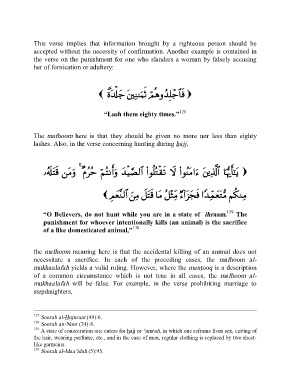
( Zot$ù#y_ tûüÏZ»uKrO óOèdrßÎ=ô_$$sù )
“Lash them eighty times.” 128
The mafhoom here is that they should be given no more nor less than eighty
lashes. Also, in the verse concerning hunting during hajj,
¼ã&s#tFs% `tBur 4 ×Pããm öNçFRr&ur yø¢Á9$# (#qè=çGø)s? w (#qãYtB#uä tûïÏ%©!$# $pkr'¯»t )
( ÉOyè¨Z9$# z`ÏB @tFs% $tB ã@÷WÏiB Öä!#tyfsù #YÏdJyètGB Nä3ZÏB
129
“O Believers, do not hunt while you are in a state of ihraam. The
punishment for whoever intentionally kills (an animal) is the sacrifice
of a like domesticated animal,” 130
the mafhoom meaning here is that the accidental killing of an animal does not
necessitate a sacrifice. In each of the preceding cases, the mafhoom al-
mukhaalafah yields a valid ruling. However, where the mantooq is a description
of a common circumstance which is not true in all cases, the mafhoom al-
mukhaalafah will be false. For example, in the verse prohibiting marriage to
stepdaughters,
127
Soorah al-Hujuraat (49):6.
128
Soorah an-Noor (24):4.
129
A state of consecration one enters for hajj or ‘umrah, in which one refrains from sex, cutting of
the hair, wearing perfume, etc., and in the case of men, regular clothing is replaced by two sheet-
like garments.
130
Soorah al-Maa’idah (5):95.
http://www.islamiconlineuniversity.com 52

