


Page 228 - Tafsir of surat at tawba repentance
P. 228
© Islamic Online University Usool at-Tafseer
The mantooq here forbids the saying of “Uff” to parents, and the mafhoom is that
cursing them or hitting them is also forbidden. Another example may be found in
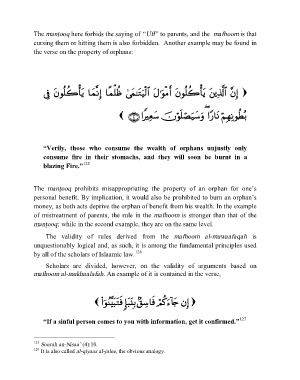
the verse on the property of orphans:
Îû tbqè=à2ù't $yJ¯RÎ) $¸Jù=àß 4yJ»tGuø9$# tAºuqøBr& tbqè=à2ù't tûïÏ%©!$# ¨bÎ) )
( ÇÊÉÈ #ZÏèy cöqn=óÁuyur ( #Y$tR öNÎgÏRqäÜç/
“Verily, those who consume the wealth of orphans unjustly only
consume fire in their stomachs, and they will soon be burnt in a
blazing Fire.” 125
The mantooq prohibits misappropriating the property of an orphan for one’s
personal benefit. By implication, it would also be prohibited to burn an orphan’s
money, as both acts deprive the orphan of benefit from his wealth. In the example
of mistreatment of parents, the rule in the mafhoom is stronger than that of the
mantooq; while in the second example, they are on the same level.
The validity of rules derived from the mafhoom al-muwaafaqah is
unquestionably logical and, as such, it is among the fundamental principles used
by all of the scholars of Islaamic law. 126
Scholars are divided, however, on the validity of arguments based on
mafhoom al-mukhaalafah. An example of it is contained in the verse,
( (#þqãY¨t6tGsù :*t6t^Î/ 7,Å$sù óOä.uä!%y` bÎ) )
“If a sinful person comes to you with information, get it confirmed.” 127
125
Soorah an-Nisaa’ (4):10.
126
It is also called al-qiyaas al-jalee, the obvious analogy.
http://www.islamiconlineuniversity.com 51

