


Page 61 - Tafsir of surat at tawba repentance
P. 61
© Islamic Online University Usool at-Tafseer
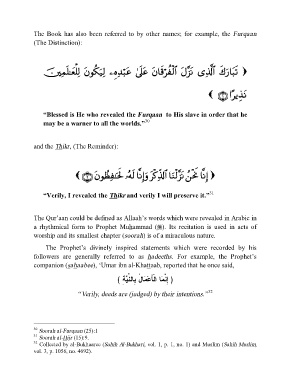
The Book has also been referred to by other names; for example, the Furqaan
(The Distinction):
úüÏJn=»yèù=Ï9 tbqä3uÏ9 ¾ÍnÏö6tã 4n?tã tb$s%öàÿø9$# tA¨tR Ï%©!$# x8u$t6s? )
( ÇÊÈ #·ÉtR
“Blessed is He who revealed the Furqaan to His slave in order that he
30
may be a warner to all the worlds.”
and the Thikr, (The Reminder):
( ÇÒÈ tbqÝàÏÿ»ptm: ¼çms9 $¯RÎ)ur tø.Ïe%!$# $uZø9¨tR ß`øtwU $¯RÎ) )
31
“Verily, I revealed the Thikr and verily I will preserve it.”
The Qur’aan could be defined as Allaah’s words which were revealed in Arabic in
a rhythmical form to Prophet Muhammad (r). Its recitation is used in acts of
worship and its smallest chapter (soorah) is of a miraculous nature.
The Prophet’s divinely inspired statements which were recorded by his
followers are generally referred to as hadeeths. For example, the Prophet’s
companion (sahaabee), ‘Umar ibn al-Khattaab, reported that he once said,
( ِﺔﻴﱢﻨﻟﺎِﺒ ُلﺎﻤﻋَﺄﹾﻟﺍ ﺎﻤﱠﻨِﺇ )
32
“Verily, deeds are (judged) by their intentions.”
30
Soorah al-Furqaan (25):1
31
Soorah al-Hijr (15):9.
32
Collected by al-Bukhaaree (Sahih Al-Bukhari, vol. 1, p. 1, no. 1) and Muslim (Sahih Muslim,
vol. 3, p. 1056, no. 4692).
http://www.islamiconlineuniversity.com 13

