


Page 119 - D&D - Player's Handbook
P. 119
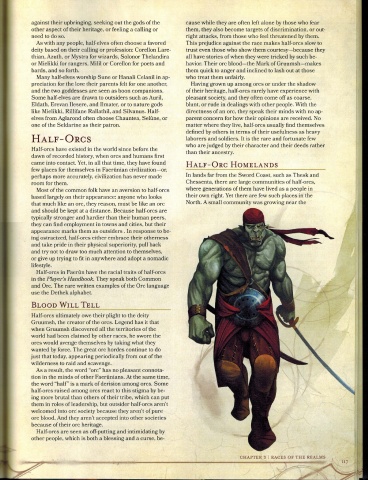
against their upbringing, seeking out the gods of the   cause while they are often left alone by those who fear
           other aspect of their heritage, or feeling a calling or   them, they also become targets of discrimination, or out-
           need to do so.                                    right attacks, from those who feel threatened by them.
             As with any people, half-elves often choose a favored   This prejudice against the race makes half-ores slow to
           deity based on their calling or profession: Corellon Lare-  trust even those who show them courtesy- because they
           thian, Azuth, or Mystra for wizards, Solonor Thelandira   all have stories of when they were tricked by such be-
           or Mielikki for rangers, Milil or Corellon for poets and   havior. Their ore blood-the Mark of Gruumsh-makes
           bards, and so forth.                              them quick to anger and inclined to lash out at those
             Many half-elves worship Sune or Hanali Celani! in ap-  who treat them unfairly.
           preciation for the love their parents felt for one another,   Having grown up among ores or under the shadow
           and the two goddesses are seen as boon companions.   of their heritage, half-ores rarely have experience with
           Some half-elves are drawn to outsiders such as Auril,   pleasant society, and they often come off as coarse,
           Eldath, Erevan Ilesere, and Ilmater, or to nature gods   blunt, or rude in dealings with other people. With the
           like Mielikki, Rillifane Rallathil, and Silvanus. Half-  directness of an ore, they speak their minds with no ap-
           elves from Aglarond often choose Chauntea, Selt'.lne, or   parent concern for how their opinions are received. No
           one of the Seldarine as their patron.             matter where they live, half-ores usually find themselves
                                                             defined by others in terms of their usefulness as heavy
           HALF-0RCS                                         laborers and soldiers. It is the rare and fortunate few
                                                             who are judged by their character and their deeds rather
           Half-ores have existed in the world since before the   than their ancestry.
           dawn of recorded history, when ores and humans first
           came into contact. Yet, in all that time, they have found
                                                             HALF-0RC HOMELANDS
           few places for themselves in Faert'.lnian civilization- or,
           perhaps more accurately, civilization has never made   In lands far from the Sword Coast, such as Thesk and
           room for them.                                    Chessenta, there are large communities of half-ores,
             Most of the common folk have an aversion to half-ores   where generations of them have lived as a people in
           based largely on their appearance: anyone who looks   their own right. Yet there are few such places in the
           that much like an ore, they reason, must be like an ore   North. A small community was growing near the
           and should be kept at a distance. Because half-ores are
           typically stronger and hardier than their human peers,
           they can find employment in towns and cities, but their
           appearance marks them as outsiders . In response to be-
           ing ostracized, half-ores either embrace their otherness
           and take pride in their physical superiority, pull back
           and try not to draw too much attention to themselves,
           or give up trying to fit in anywhere and adopt a nomadic
           lifestyle.
             Half-ores in Faert'.ln have the racial traits of half-ores
           in the Player's Handbook. They speak both Common
           and Ore. The rare written examples of the Ore language
           use the Dethek alphabet.
           BLOOD WILL TELL
           Half-ores ultimately owe their plight to the deity
           Gruumsh, the creator of the ores. Legend has it that
           when Gruumsh discovered all the territories of the
           world had been claimed by other races, he swore the
           ores would avenge themselves by taking what they
           wanted by force. The great ore hordes continue to do
           just that today, appearing periodically from out of the
           wilderness to raid and scavenge.
             As a result, the word "ore" has no pleasant connota-
           tion in the minds of other Faert'.lnians. At the same time,
           the word "half" is a mark of derision among ores. Some
           half-ores raised among ores react to this stigma by be-
           ing more brutal than others of their tribe, which can put
           them in roles of leadership, but outsider half-ores aren't
           welcomed into ore society because they aren't of pure
           ore blood. And they aren't accepted into other societies
           because of their ore heritage.
             Half-ores are seen as off-putting and intimidating by
           other people, which is both a blessing and a curse, be-

