


Page 115 - D&D - Player's Handbook
P. 115
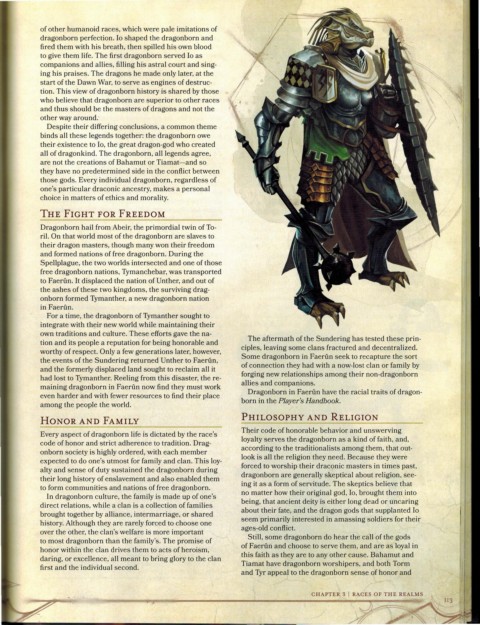
of other humanoid races, which were pale imitations of
           dragonborn perfection. Io shaped the dragonborn and
           fired them with his breath, then spilled his own blood
           to give them life. The first dragonborn served Io as
           companions and allies, filling his astral court and sing-
           ing his praises. The dragons he made only later, at the
           start of the Dawn War, to serve as engines of destruc-
           tion. This view of dragonborn history is shared by those
           who believe that dragonborn are superior to other races
           and thus should be the masters of dragons and not the
           other way around.
             Despite their differing conclusions, a common theme
           binds all these legends together: the dragonborn owe
           their existence to Io, the great dragon-god who created
           all of dragonkind. The dragonborn, all legends agree,
           are not the creations of Bahamut or Tiamat- and so
           they have no predetermined side in the conflict between
           those gods. Every individual dragonborn, regardless of
           one's particular draconic ancestry, makes a personal
           choice in matters of ethics and morality.

           THE FIGHT FOR FREEDOM
           Dragon born hail from Abeir, the primordial twin of To-
           ri!. On that world most of the dragonborn are slaves to
           their dragon masters, though many won their freedom
           and formed nations of free dragon born. During the
           Spellplague, the two worlds intersected and one of those
           free dragonborn nations, Tymanchebar, was transported
           to FaerG.n. It displaced the nation of Unther, and out of
           the ashes of these two kingdoms, the surviving drag-
           onborn formed Tymanther, a new dragonborn nation
           in FaerG.n.
             For a time, the dragonborn of Tymanther sought to
           integrate with their new world while maintaining their
           own traditions and culture. These efforts gave the na-
                                                               The aftermath of the Sundering has tested these prin-
           tion and its people a reputation for being honorable and
                                                             ciples, leaving some clans fractured and decentralized.
           worthy of respect. Only a few generations later, however,
                                                             Some dragonborn in FaerG.n seek to recapture the sort
           the events of the Sundering returned Unther to FaerG.n,
                                                             of connection they had with a now-lost clan or family by
           and the formerly displaced land sought to reclaim all it
                                                             forging new relationships among their non-dragonborn
           had lost to Tymanther. Reeling from this disaster, the re-
                                                             allies and companions.
           maining dragonborn in FaerG.n now find they must work
                                                               Dragonborn in FaerG.n have the racial traits of dragon-
           even harder and with fewer resources to find their place
                                                             born in the Player's Handbook.
           among the people the world.
                                                             PHILOSOPHY AND  RELIGION
           HONOR AND  FAMILY
                                                             Their code of honorable behavior and unswerving
           Every aspect of dragonborn life is dictated by the race's
           code of honor and strict adherence to tradition. Drag-  loyalty serves the dragonborn as a kind of faith, and,
                                                             according to the traditionalists among them, that out-
           onborn society is highly ordered, with each member
                                                             look is all the religion they need. Because they were
           expected to do one's utmost for family and clan. This loy-
                                                             forced to worship their draconic masters in times past,
           alty and sense of duty sustained the dragonborn during
                                                             dragonborn are generally skeptical about religion, see-
           their long history of enslavement and also enabled them
                                                             ing it as a form of servitude. The skeptics believe that
           to form communities and nations of free dragon born.
             In dragonborn culture, the family is made up of one's   no matter how their original god, Io, brought them into
                                                             being, that ancient deity is either long dead or uncaring
           direct relations, while a clan is a collection of families
                                                             about their fate, and the dragon gods that supplanted Io
           brought together by alliance, intermarriage, or shared
                                                             seem primarily interested in amassing soldiers for their
           history. Although they are rarely forced to choose one
                                                             ages-old conflict.
           over the other, the clan's welfare is more important
                                                               Still, some dragonborn do hear the call of the gods
           to most dragonborn than the family's. The promise of
                                                             of FaerG.n and choose to serve them, and are as loyal in
           honor within the clan drives them to acts of heroism
           daring, or excellence, all meant to bring glory to the ~Ian   this faith as they are to any other cause. Bahamut and
                                                             Tiamat have dragonborn worshipers, and both Torm
           first and the individual second.
                                                             and Tyr appeal to the dragonborn sense of honor and

