


Page 125 - D&D - Player's Handbook
P. 125
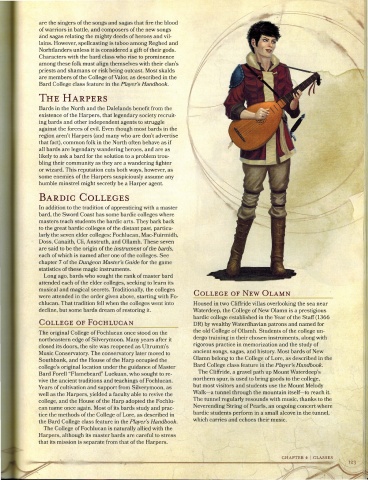
are the singers of the songs and sagas that fire the blood
              of warriors in battle, and composers of the new songs
              and sagas relating the mighty deeds of heroes and vil-
              lains. However, spellcasting is taboo among Reghed and
              Norhtlanders unless it is considered a gift of their gods.
              Characters with the bard class who rise to prominence
              among these folk must align themselves with their clan's
              priests and shamans or risk being outcast. Most skalds
              are members of the College of Valor, as described in the
              Bard College class feature in the Player's Handbook.

              THE HARPERS
              Bards in the North and the Dalelands benefit from the
              existence of the Harpers, that legendary society recruit-
              ing bards and other independent agents to struggle
              against the forces of evil. Even though most bards in the
              region aren't Harpers (and many who are don't advertise
              that fact), common folk in the North often behave as if
              all bards are legendary wandering heroes, and are as
              likely to ask a bard for the solution to a problem trou-
              bling their community as they are a wandering fighter
              or wizard. This reputation cuts both ways, however, as
              some enemies of the Harpers suspiciously assume any
              humble minstrel might secretly be a Harper agent.

              BARDIC  COLLEGES
              In addition to the tradition of apprenticing with a master
              bard, the Sword Coast has some bardic colleges where
              masters teach students the bardic arts. They hark back
              to the great bardic colleges of the distant past, particu-
              larly the seven elder colleges: Fochlucan, Mac-Fuirmidh,
              Doss, Canaith, Cli, Anstruth, and Ollamh. These seven
              are said to be the origin of the instrument of the bards,
              each of which is named after one of the colleges. See
              chapter 7 of the Dungeon Master's Guide for the game
              statistics of these magic instruments.
               Long ago, bards who sought the rank of master bard
              attended each of the elder colleges, seeking to learn its
              musical and magical secrets. Traditionally, the colleges
                                                                COLLEGE  OF  NEW OLAMN
              were attended in the order given above, starting with Fo-
              chlucan. That tradition fell when the colleges went into   Housed in two Cliffride villas overlooking the sea near
              decline, but some bards dream of restoring it.    Waterdeep, the College of New Olamn is a prestigious
                                                                bardic college established in the Year of the Staff (1366
              COLLEGE  OF FOCHLUCAN                             DR) by wealthy Waterdhavian patrons and named for
              The original College of Fochlucan once stood on the   the old College of Ollamh. Students of the college un-
                                                                dergo training in their chosen instruments, along with
              northeastern edge of Silverymoon. Many years after it
                                                                rigorous practice in memorization and the study of
              closed its doors, the site was reopened as Ultrumm's
              Music Conservatory. The conservatory later moved to   ancient songs, sagas, and history. Most bards of New
              Southbank, and the House of the Harp occupied the   Olamn belong to the College of Lore, as described in the
              college's original location under the guidance of Master   Bard College class feature in the Player's Handbook.
              Bard Fore!! "Flamebeard" Luekuan, who sought to re-  The Cliffride, a gravel path up Mount Waterdeep's
              vive the ancient traditions and teachings of Fochlucan.   northern spur, is used to bring goods to the college,
              Years of cultivation and support from Silverymoon, as   but most visitors and students use the Mount Melody
              well as the Harpers, yielded a faculty able to revive the   Walk- a tunnel through the mountain itself-to reach it.
              college, and the House of the Harp adopted the Fochlu-  The tunnel regularly resounds with music, thanks to the
              can name once again. Most of its bards study and prac-  Neverending String of Pearls, an ongoing concert where
              tice the methods of the College of Lore, as described in   bardic students perform in a small alcove in the tunnel,
              the Bard College class feature in the Player's Handbook.   which carries and echoes their music.
               The College of Fochlucan is naturally allied with the
              Harpers, although its master bards are careful to stress
              that its mission is separate from that of the Harpers.

