


Page 6 - Owners
P. 6
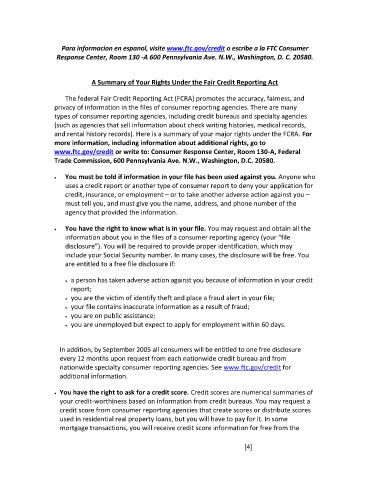
Para informacion en espanol, visite www.ftc.gov/credit o escribe a la FTC Consumer
                    Response Center, Room 130 -A 600 Pennsylvania Ave. N.W., Washington, D. C. 20580.


                               A Summary of Your Rights Under the Fair Credit Reporting Act


                       The federal Fair Credit Reporting Act (FCRA) promotes the accuracy, fairness, and
                   privacy of information in the files of consumer reporting agencies. There are many
                   types of consumer reporting agencies, including credit bureaus and specialty agencies
                   (such as agencies that sell information about check writing histories, medical records,
                   and rental history records). Here is a summary of your major rights under the FCRA. For
                   more information, including information about additional rights, go to
                   www.ftc.gov/credit or write to: Consumer Response Center, Room 130-A, Federal
                   Trade Commission, 600 Pennsylvania Ave. N.W., Washington, D.C. 20580.


                   •   You must be told if information in your file has been used against you. Anyone who
                       uses a credit report or another type of consumer report to deny your application for
                       credit, insurance, or employment – or to take another adverse action against you –
                       must tell you, and must give you the name, address, and phone number of the
                       agency that provided the information.


                   •   You have the right to know what is in your file. You may request and obtain all the
                       information about you in the files of a consumer reporting agency (your “file
                       disclosure”). You will be required to provide proper identification, which may
                       include your Social Security number. In many cases, the disclosure will be free. You
                       are entitled to a free file disclosure if:

                       •  a person has taken adverse action against you because of information in your credit
                        report;
                       •  you are the victim of identify theft and place a fraud alert in your file;
                       •  your file contains inaccurate information as a result of fraud;
                       •  you are on public assistance;
                       •  you are unemployed but expect to apply for employment within 60 days.


                     In addition, by September 2005 all consumers will be entitled to one free disclosure
                     every 12 months upon request from each nationwide credit bureau and from
                     nationwide specialty consumer reporting agencies. See www.ftc.gov/credit for
                     additional information.

                   •  You have the right to ask for a credit score. Credit scores are numerical summaries of
                     your credit-worthiness based on information from credit bureaus. You may request a
                     credit score from consumer reporting agencies that create scores or distribute scores
                     used in residential real property loans, but you will have to pay for it. In some
                     mortgage transactions, you will receive credit score information for free from the

                                                                                  [4]

