


Page 36 - law prep tutorial gk compendium 2021.cdr
P. 36
CLAT 2021                                                                      21 Year Experienced Team


        It keeps round the clock watch over the North Indian Ocean and detects, tracks and predicts cyclonic storms
        using numerical models for tropical cyclone track and intensity prediction.
         It issues cyclone advisories 8 times a day to the panel countries of WMO/ESCAP.

         The IMD also implements the Regional Cyclone Operational Plan of WMO/ESCAP Panel.
        The National Disaster Response Force (NDRF) is tasked with carrying out rescue and relief operations under
        the National Disaster Management Act 2005.
        National  Cyclone  Risk  Mitigation  Project  (NCRMP):  This  World  Bank  supported  project  aims  to
        undertake suitable structural and non-structural measures to mitigate the effects of cyclones in the coastal
        states and UTs of India.  The Project has identified 13 cyclone prone States and Union Territories (UTs) and
        has  classified  them  into  two  categories  based  on  their  vulnerability  as  follows:    Category  I:  Higher
        vulnerability States i.e. Andhra Pradesh, Gujarat, Odisha, Tamil Nadu and West Bengal.  Category II: Lower
        vulnerability States i.e Maharashtra, Karnataka, Kerala, Goa, Pondicherry, Lakshadweep, Daman and Diu,
        Andaman and Nicobar Islands.  National Disaster Management Authority (NDMA) under the aegis of Ministry
        of Home Affairs (MHA) will implement the Project in coordination with participating State Governments.

         Mobile Apps: 'Mausam' was launched by IMD to provide timely weather updates to the users.
        'Meghdoot' app provides similar service in local languages to farmers for planning crops.
        'Damini Lightning' provides lightning and thunderstorm forecasts and locations of occurrence.
        What are Cyclones and how they are Named?

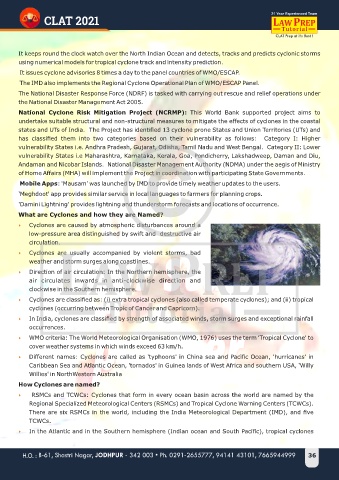
        f   Cyclones are caused by atmospheric disturbances around a
           low-pressure area distinguished by swift and  destructive air
           circulation.
        f   Cyclones  are  usually  accompanied  by  violent  storms,  bad
           weather and storm surges along coastlines.
        f   Direction of air circulation: In the Northern hemisphere, the
           air  circulates  inwards  in  anti-clockwise  direction  and
           clockwise in the Southern hemisphere.
        f   Cyclones are classified as: (i) extra tropical cyclones (also called temperate cyclones); and (ii) tropical
           cyclones (occurring between Tropic of Cancer and Capricorn).
        f   In India, cyclones are classified by strength of associated winds, storm surges and exceptional rainfall
           occurrences.

        f   WMO criteria: The World Meteorological Organisation (WMO, 1976) uses the term 'Tropical Cyclone' to
           cover weather systems in which winds exceed 63 km/h.

        f   Different names: Cyclones are called as 'typhoons' in China sea and Pacific Ocean, 'hurricanes' in
           Caribbean Sea and Atlantic Ocean, 'tornados' in Guinea lands of West Africa and southern USA, 'Willy
           Willies' in NorthWestern Australia
       How Cyclones are named?
       f    RSMCs and TCWCs: Cyclones that form in every ocean basin across the world are named by the
           Regional Specialized Meteorological Centers (RSMCs) and Tropical Cyclone Warning Centers (TCWCs).
           There are six RSMCs in the world, including the India Meteorological Department (IMD), and five
           TCWCs.
       f   In the Atlantic and in the Southern hemisphere (Indian ocean and South Pacific), tropical cyclones


         H.O. :                                                                                              36

