


Page 35 - law prep tutorial gk compendium 2021.cdr
P. 35
CLAT 2021                                                                      21 Year Experienced Team


              Developing Resilience To Cyclones: Changing Patterns And

                                       Increasing Risk

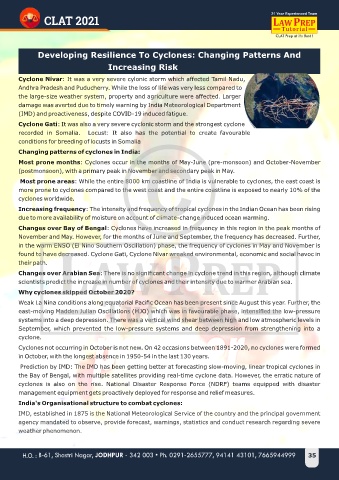
        Cyclone Nivar: It was a very severe cylonic storm which affected Tamil Nadu,
        Andhra Pradesh and Puducherry. While the loss of life was very less compared to
        the large-size weather system, property and agriculture were affected. Larger
        damage was averted due to timely warning by India Meteorological Department
        (IMD) and proactiveness, despite COVID-19 induced fatigue.

        Cyclone Gati: It was also a very severe cyclonic storm and the strongest cyclone
        recorded  in  Somalia.    Locust:  It  also  has  the  potential  to  create  favourable
        conditions for breeding of locusts in Somalia

        Changing patterns of cyclones in India:
        Most prone months: Cyclones occur in the months of May-June (pre-monsoon) and October-November
        (postmonsoon), with a primary peak in November and secondary peak in May.
         Most prone areas: While the entire 8000 km coastline of India is vulnerable to cyclones, the east coast is
        more prone to cyclones compared to the west coast and the entire coastline is exposed to nearly 10% of the
        cyclones worldwide.
        Increasing frequency: The intensity and frequency of tropical cyclones in the Indian Ocean has been rising
        due to more availability of moisture on account of climate-change induced ocean warming.

        Changes over Bay of Bengal: Cyclones have increased in frequency in this region in the peak months of
        November and May. However, for the months of June and September, the frequency has decreased. Further,
        in the warm ENSO (El Nino Southern Oscillation) phase, the frequency of cyclones in May and November is
        found to have decreased. Cyclone Gati, Cyclone Nivar wreaked environmental, economic and social havoc in
        their path.
        Changes over Arabian Sea: There is no significant change in cyclone trend in this region, although climate
        scientists predict the increase in number of cyclones and their intensity due to warmer Arabian sea.

        Why cyclones skipped October 2020?
        Weak La Nina conditions along equatorial Pacific Ocean has been present since August this year. Further, the
        east-moving Madden Julian Oscillations (MJO) which was in favourable phase, intensified the low-pressure
        systems into a deep depression. There was a vertical wind shear between high and low atmospheric levels in
        September, which prevented the low-pressure systems and deep depression from strengthening into a
        cyclone.

        Cyclones not occurring in October is not new. On 42 occasions between 1891-2020, no cyclones were formed
        in October, with the longest absence in 1950-54 in the last 130 years.
         Prediction by IMD: The IMD has been getting better at forecasting slow-moving, linear tropical cyclones in
       the Bay of Bengal, with multiple satellites providing real-time cyclone data. However, the erratic nature of
       cyclones  is  also  on  the  rise.  National  Disaster  Response  Force  (NDRF)  teams  equipped  with  disaster
       management equipment gets proactively deployed for response and relief measures.
       India's Organisational structure to combat cyclones:
       IMD, established in 1875 is the National Meteorological Service of the country and the principal government
       agency mandated to observe, provide forecast, warnings, statistics and conduct research regarding severe
       weather phenomenon.


         H.O. :                                                                                              35

