


Page 240 - Fanar
P. 240
i                                                                           Technical Information


            4.10. Recommendations for Processing with Machine Taps


            Tapping is usually one of the last operations in the process of machining a workpiece. An error occurring in the
            process of tapping may result in additional costs associated not only with the damaged tap, but often with the
            workpiece material, as well as with the machining processes preceding the tapping. In order to avoid such
            problems, we encourage you to read and apply the below recommendations regarding the tapping process.

            4.11. Threading process


                            Operation                                     Recommendations
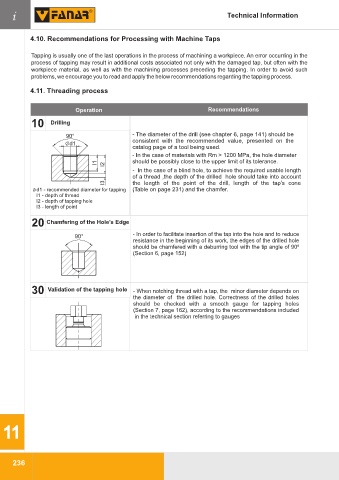
            10     Drilling


                         90°                    - The diameter of the drill (see chapter 6, page 141) should be
                                                consistent  with  the  recommended  value,  presented  on  the
                         d1
                                                catalog page of a tool being used.
                                                -  In the case of materials with Rm > 1200 MPa, the hole diameter
                                    l1    l2    should be possibly close to the upper limit of its tolerance.
                                                -  In the case of a blind hole, to achieve the required usable length
                                                of a thread ,the depth of the drilled  hole should take into account
                                       l3       the  length  of  the  point  of  the  drill,  length  of  the  tap’s  cone
              d1 - recommended diameter for tapping  (Table on page 231) and the chamfer.
              l1 - depth of thread
              l2 - depth of tapping hole
              l3 - length of point

            20   Chamfering of the Hole’s Edge

                            90°                 - In order to facilitate insertion of the tap into the hole and to reduce
                                                resistance in the beginning of its work, the edges of the drilled hole
                                                should be chamfered with a deburring tool with the tip angle of 90⁰
                                                (Section 6, page 152)


            30    Validation of the tapping hole  - When notching thread with a tap, the  minor diameter depends on
                                                the diameter of  the drilled hole. Correctness of the drilled holes
                                                should  be  checked  with  a  smooth  gauge  for  tapping  holes
                                                (Section 7, page 162), according to the recommendations included
                                                 in the technical section referring to gauges


  11


      236

