


Page 39 - analysis-and-interpretation-of-astronomical-sp
P. 39
Analysis and Interpretation of Astronomical Spectra                                                                                              39

9 Visible Effects of Quantum Mechanics

9.1 Textbook Example Hydrogen Atom and Balmer Series

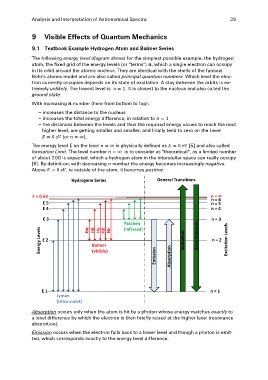
The following energy level diagram shows for the simplest possible example, the hydrogen

atom, the fixed grid of the energy levels (or "terms") , which a single electron can occupy

in its orbit around the atomic nucleus. They are identical with the shells of the famous
Bohr's atomic model and are also called principal quantum numbers. Which level the elec-

tron currently occupies depends on its state of excitation. A stay between the orbits is ex-

tremely unlikely. The lowest level is       . It is closest to the nucleus and also called the

ground state.

With increasing number (here from bottom to top):

        – increases the distance to the nucleus
        – increases the total energy difference, in relation to
        – the distances between the levels and thus the required energy values to reach the next

          higher level, are getting smaller and smaller, and finally tend to zero on the Level
                     (or ).

The energy level E on the level             is physically defined as  [5] and also called

Ionisation Limit. The level number          is to consider as "theoretical", as a limited number

of about 200 is expected, which a hydrogen atom in the interstellar space can really occupy
[6]. By definition, with decreasing number the energy becomes increasingly negative.

Above          , ie outside of the atom, it becomes positive.

               Hydrogene Series                         General Transitions

E = 0 eV                                                                     nn  ==  ∞
      E5                                                                             6
      E4                                                                     n=5
      E3
                                                                             n=4
      E2
                                                                             n=3
        Energy Levels                       Paschen
                                      Hα    (Infrared)
                                          Hβ
                                             Hγ                              n=2
                                                Hδ
                                                    HεBalmer
                                 (visible)
                                                                                Emission
                                                                                          Absorption

                                                                                                  Ionization
                                                                                                           Recombination
                                                                                                                              Excitation Levels

        E1                                                                   n=1
                 Lyman
                 (Ultra violet)

Absorption occurs only when the atom is hit by a photon whose energy matches exactly to
a level difference by which the electron is then briefly raised at the higher level (resonance
absorption).

Emission occurs when the electron falls back to a lower level and though a photon is emit-
ted, which corresponds exactly to the energy level difference.

