


Page 38 - analysis-and-interpretation-of-astronomical-sp
P. 38
Analysis and Interpretation of Astronomical Spectra                  38

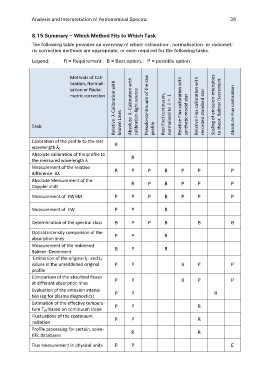
8.15 Summary – Which Method Fits to Which Task
The following table provides an overview of which calibration-, normalisation- or radiomet-
ric correction methods are appropriate, or even required for the following tasks.

Legend:  R = Requirement B = Best option, P = possible option

         Methods of Cali-               Relative λ-Calibration with
         bration, Normali-                 known Lines
         sation or Radio-                         Absolute λ- Calibration with
         metric correction                           calibration-light-source
                                                            Pseudo-continuum of the raw
Task                                                           profile
                                                                      Rectified continuum,
                                                                          normalised to
                                                                                Relative Flux calibration with
                                                                                    synthetic model star
                                                                                          Relative Flux calibration with
                                                                                              recorded standard star
                                                                                                    Scaling of emission-intensities
                                                                                                        to theor. Balmer Decrement
                                                                                                                Absolute Flux calibration

Calibration of the profile to the rest  R
wavelength λ0

Absolute calibration of the profile to     R
the measured wavelength λ

Measurement of the relative             RPPBPP                       P
difference Δλ                                                        P
                                                                     P
Absolute Measurement of the                RPBPP
Doppler shift

Measurement of FWHM                     PPPBPP

Measurement of EW                       PP              R

Determination of the spectral class     B  P         P  B      B     B

Optical intensity comparison of the     P  P            R
absorption lines                        B  P            R

Measurement of the reddened             P  P               BP        P
Balmer -Decrement
Estimation of the original IE- and IA-  P  P               BP        P
values in the unreddened original       P  P
profile                                 P  P                      R
Comparison of the absorbed fluxes       P  P
at different absorption lines              R                   R

Evaluation of the emission intensi-                            R
ties (eg for plasma diagnostics)
                                                               R
Estimation of the effective tempera-
ture Teff based on continuum slope

Fluctuations of the continuum
radiation

Profile processing for certain, scien-
tific databases

Flux measurement in physical units P       P                         E

