


Page 103 - spectroscopic-atlas-5_0-english_Neat
P. 103
Spectroscopic Atlas for Amateur Astronomers 103
23 Carbon Stars on the AGB
23.1 Overview and Spectral Characteristics
The final stage of the stellar evolution on the AGB is formed by the deeply red shining car-
bon stars, in most of the cases also Mira Variables or „Carbon Miras“. In the atmosphere of
a star, finally moving to the upper part of the AGB, the C/O ratio becomes ܥ⁄ܱ > 1. This
results in a carbon excess which accumulates in a circumstellar cloud, dominating now im-
pressively the star's spectrum. Thus, in the intermediate class SC, and increasingly in the
following C–Class, moderately high resolution spectra show now predominantly absorp-
tions of diatomic carbon molecules. In addition to CH and CN the so-called Swan bands due
to C2 are particularly striking – discovered in 1856 by the Scot William Swan. (see also Ta-
ble 110). Further visible are atomic lines of S–Process products and impressive absorptions
of Na I. Angelo Secchi was the first to discover that the intensity gradient of the C2 Swan
bands is reversed [ ] in contrast to other molecular absorptions, such as titanium-
and zirconium oxide. For this feature, he created the separate spectral class lV. (see appen-
dix 34.3).
23.2 Competing Classification Systems
The phenomenon of carbon stars is still far from being fully understood (see e.g. [106]). For
the S–class, in spite of ongoing disputes it exist a generally accepted and consistently ap-
plied classification system. However for the carbon stars – the situation is still confusing
and unsatisfactory. The “Revised MK-System 1993”, propagated in most of the textbooks,
is applied obviously rarely. Its precursor from the 1960's, the so-called MK–C system, how-
ever, very often! Surprisingly frequent one can see even classifications according to the
much older Harvard system, with the R and N classes.
23.3 The Morgan Keenan (MK) – C System
This simple, old classification system is still very popular, both in many professional publi-
cations, as well as in most of the stellar databases. It uses the following format:
CX, n
X: defines on a scale of 0 – 7, the position of the star in the temperature sequence.
This scale is temperature equivalent to the spectral classes from G4 to M4 (see
table below). The system appears to have been extended down to C9 (e.g. WZ Cas).
n: This index rates on a scale from 1 – 5, the intensity of the C2 Swan bands. In
individual cases, appropriate supplements may be added, for example (e) for
emission lines, further also intensive lines of S–Process elements.
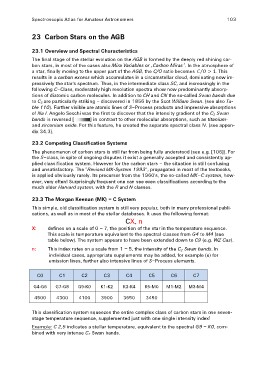
C0 C1 C2 C3 C4 C5 C6 C7
G4-G6 G7-G8 G9-K0 K1-K2 K3-K4 K5-M0 M1-M2 M3-M4
4500 4300 4100 3900 3650 3450
This classification system squeezes the entire complex class of carbon stars in one seven-
stage temperature sequence, supplemented just with one single intensity index!
Example: C 2,5 indicates a stellar temperature, equivalent to the spectral G9 – K0, com-
bined with very intense C2 Swan bands.

