


Page 106 - spectroscopic-atlas-5_0-english_Neat
P. 106
Spectroscopic Atlas for Amateur Astronomers                                           106

23.7 Commented Spectra

The majority of carbon stars is part of the sub-class C–N, documented here with some ex-
amples. The spectral classes are here indicated in the old MK–C system, according to Ste-
phenson's 1989 catalog [500]. If available [107], also the classification, corresponding to
the “Revised MK System 1993" is specified.

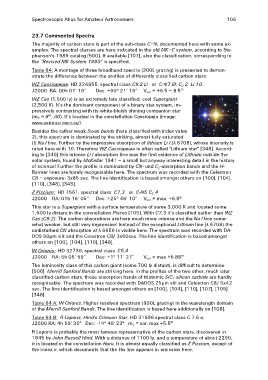
Table 64: A montage of three broadband spectra (200L grating) is presented to demon-
strate the difference between the profiles of differently classified carbon stars.

WZ Cassiopeiae: HD 224855, spectral class C9,2 Li or C-N7 III: C2 2 Li 10.
J2000 RA: 00h 01‘ 16‘‘ Dec: +60° 21‘ 19“ Vvar ≈ +6.5 – 8.5m

WZ Cas (1,500 ly) is an extremely late classified, cool Supergiant
(2,500 K). It’s the dominant component of a binary star system, im-
pressively contrasting with its white-bluish shining companion star
(mV ≈ 8m, A0). It’s located in the constellation Cassiopeia (image:
www.astro.sci.muni.cz/).

Besides the rather weak Swan bands (here classified with index value
2), this spectrum is dominated by the striking, almost fully saturated
(!) Na I line. Further by the impressive absorption of lithium Li I (λ 6708), whose intensity is
rated here with 10. Therefore WZ Cassiopeiae is often called "Lithium star" [348]. Accord-
ing to [349] this intense Li l absorption line was the first evidence of Lithium outside the
solar system, found by McKellar 1941 – a small but anyway interesting detail in the history
of science! Further the profile is dominated by CN- und C2-absorption bands and the H-
Balmer lines are barely recognisable here. The spectrum was recorded with the Celestron
C8 – exposure: 3x85 sec. The line identification is based amongst others on [100], [104],
[110], [348], [349].

Z Piscium: HD 7561, spectral class C7,3 or C-N5 C2 4
J2000 RA: 01h 16‘ 05‘‘ Dec: +25° 46‘ 10“ Vvar ≈ max. +6.8m

This star is a Supergiant with a surface temperature of some 3,000 K and located some
1,500 ly distant in the constellation Pisces [105]. With C7,3 it’s classified earlier than WZ
Cas (C9.2). The carbon absorptions are here much more intense and the Na l line some-
what weaker, but still very impressive! Instead of the exceptional Lithium line (λ 6708) the
undisturbed CN absorption at λ 6656 is visible here. The spectrum was recorded with DA-
DOS 50μm slit and the Celestron C8/ 3x60sec. The line identification is based amongst
others on [100], [104], [110], [348].

W Orionis: HD 32736, spectral class C5,4     Vvar ≈ max.+5.88m
J2000 RA: 5h 05‘ 59“ Dec: +1° 11‘ 27“

The luminosity class of this carbon giant (some 700 ly distant), is difficult to determine
[506]. Merrill Sanford Bands are striking here. In the profiles of the two other, much later
classified carbon stars, these absorption bands of triatomic SiC2 silicon carbide are hardly
recognisable. The spectrum was recorded with DADOS 25μm slit and Celestron C8/ 5x42
sec. The line identification is based amongst others on [100], [104], [110], [107], [109]
[348].

Table 64 A: W Orionis. Higher resolved spectrum (900L grating) in the wavelength domain
of the Merrill Sanford Bands. The line identification is based here additionally on [108].

Table 64 B: R Leporis, Hind's Crimson Star, HD 31996 spectral class C 7.6 e,
J2000 RA: 4h 59' 36" Dec: -14° 48' 23" mV = var. max +5.5m

R Leporis is probably the most famous representative of the carbon stars, discovered in
1845 by John Russell Hind. With a distance of 1100 ly, and a temperature of about 2290,
it is located in the constellation Hare. It is almost equally classified as Z Piscium, except of
the index e, which documents that the Hα line appears in emission here.

