


Page 104 - spectroscopic-atlas-5_0-english_Neat
P. 104
Spectroscopic Atlas for Amateur Astronomers                                  104

23.4 The „Revised MK System 1993“

In 1993, the old "C system" was revised to the "Revised MK System 1993" and adapted to
new findings [107]. It comprises five sub-classes (!), ordered by spectral symptoms –
whose astrophysical background however remains widely unclear. Perhaps this could be
one reason why the acceptance of this complex system, even some 20 years after its intro-
duction, seems to be still limited. The "Keenan 1993 system” uses the following format:

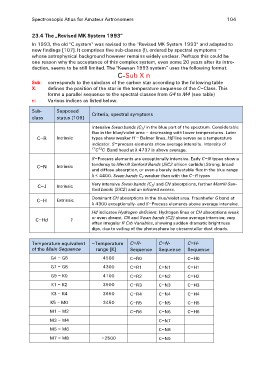
                                    C–Sub X n

Sub: corresponds to the subclass of the carbon star according to the following table
X: defines the position of the star in the temperature sequence of the C–Class. This

         forms a parallel sequence to the spectral classes from G4 to M4 (see table)
n: Various indices as listed below.

Sub-   Supposed
class                       Criteria, spectral symptoms

       status [106]

C–R Intrinsic           Intensive Swan bands (C2) in the blue part of the spectrum. Considerable
                        flux in the blue/violet area – decreasing with lower temperatures. Later
C–N Intrinsic           types show weaker H – Balmer lines, Hβ line serves as a temperature
                        indicator. S–process elements show average intensity. Intensity of
C–J Intrinsic           12C13C Band head at λ 4737 is above average.
C–H Extrinsic
                        S–Process elements are exceptionally intensive. Early C–N types show a
C–Hd   ?                tendency to Merrill Sanford Bands (SiC2 silicon carbide).Strong, broad
                        and diffuse absorption, or even a barely detectable flux in the blue range
                        λ < 4400. Swan bands C2 weaker than with the C–R types

                        Very intensive Swan bands (C2) and CN absorptions, further Merrill San-
                        ford bands (SiC2) and an infrared excess.

                        Dominant CH absorptions in the blue/violet area. Fraunhofer G band at
                        λ 4300 exceptionally- and S–Process elements above average intensive.

                        Hd indicates Hydrogen deficient. Hydrogen lines or CH absorptions weak
                        or even absent. CN and Swan bands (C2) above average intensive, very
                        often irregular R Crb Variables, showing sudden dramatic brightness
                        dips, due to veiling of the photosphere by circumstellar dust clouds.

Temperature equivalent  ~Temperature  C–R-               C–N-      C–H-
of the Main Sequence      range [K]   Sequence           Sequence  Sequence
                               4500   C–R0                         C–H0
            G4 – G6            4300   C–R1               C–N1      C–H1
            G7 – G8            4100   C–R2               C–N2      C–H2
            G9 – K0            3900   C–R3               C–N3      C–H3
            K1 – K2            3650   C–R4               C–N4      C–H4
            K3 – K4            3450   C–R5               C–N5      C–H5
            K5 – M0                   C–R6               C–N6      C–H6
            M1 – M2           ~2500                      C–N7
            M3 – M4                                      C–N8
            M5 – M6                                      C–N9
            M7 – M8

