


Page 142 - spectroscopic-atlas-5_0-english_Neat
P. 142
Spectroscopic Atlas for Amateur Astronomers                                 142

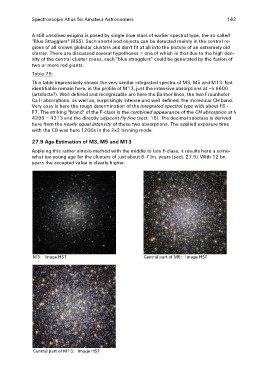
A still unsolved enigma is posed by single blue stars of earlier spectral type, the so-called
"Blue Stragglers" (BSS). Such short-lived objects can be detected mainly in the central re-
gions of all known globular clusters and don't fit at all into the picture of an extremely old
cluster. There are discussed several hypotheses – one of which is that due to the high den-
sity of the central cluster zones, such "blue stragglers" could be generated by the fusion of
two or more red giants.

Table 79:

This table impressively shows the very similar integrated spectra of M3, M5 and M13. Not
identifiable remain here, in the profile of M13, just the intensive absorptions at ~λ 6600
(artefacts?). Well defined and recognizable are here the Balmer lines, the two Fraunhofer
Ca II absorptions, as well as, surprisingly intense and well defined, the molecular CH band.
Very easy is here the rough determination of the integrated spectral type with about F6 -
F7. The striking "brand" of the F-class is the combined appearance of the CH absorption at λ
4299 – 4313 and the directly adjacent Hγ line (sect. 16). The decimal subclass is derived
here from the nearly equal intensity of these two absorptions. The applied exposure time
with the C8 was here 1200s in the 2x2 binning mode.

27.9 Age Estimation of M3, M5 and M13

Applying this rather simple method with the middle to late F-class, it results here a some-
what too young age for the clusters of just about 6-7 bn. years (sect. 27.5). With 12 bn.
years the accepted value is clearly higher.

M3: Image HST                                Central part of M5: Image HST

Central part of M13: Image HST

