


Page 147 - spectroscopic-atlas-5_0-english_Neat
P. 147
Spectroscopic Atlas for Amateur Astronomers 147
28.5 Supernova Remnants SNR
SNR show a striking filamentary structure. The main part of
the ionisation energy is provided here by the collision of
the rapidly expanding stellar envelope (a few 1000 km/s)
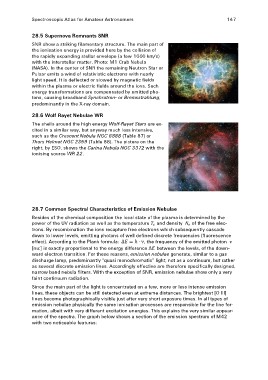
with the interstellar matter. Photo: M1 Crab Nebula
(NASA). In the center of SNR the remaining Neutron Star or
Pulsar emits a wind of relativistic electrons with nearly
light speed. It is deflected or slowed by magnetic fields
within the plasma or electric fields around the ions. Such
energy transformations are compensated by emitted pho-
tons, causing broadband Synchrotron- or Bremsstrahlung,
predominantly in the X-ray domain.
28.6 Wolf Rayet Nebulae WR
The shells around the high energy Wolf-Rayet Stars are ex-
cited in a similar way, but anyway much less intensive,
such as the Crescent Nebula NGC 6888 (Table 87) or
Thors Helmet NGC 2359 (Table 88). The picture on the
right, by ESO, shows the Carina Nebula NGC 3372 with the
ionising source WR 22.
28.7 Common Spectral Characteristics of Emission Nebulae
Besides of the chemical composition the local state of the plasma is determined by the
power of the UV radiation as well as the temperature ܶ and density ܰ of the free elec-
trons. By recombination the ions recapture free electrons which subsequently cascade
down to lower levels, emitting photons of well defined discrete frequencies (fluorescence
effect). According to the Plank formula: ∆ = ܧℎ ∙ ߥ, the frequency of the emitted photon ߥ
[nu:] is exactly proportional to the energy difference ∆ ܧbetween the levels, of the down-
ward electron transition. For these reasons, emission nebulae generate, similar to a gas
discharge lamp, predominantly “quasi monochromatic” light, not as a continuum, but rather
as several discrete emission lines. Accordingly effective are therefore specifically designed,
narrow band nebula filters. With the exception of SNR, emission nebulae show only a very
faint continuum radiation.
Since the main part of the light is concentrated on a few, more or less intense emission
lines, these objects can be still detected even at extreme distances. The brightest [O III]
lines become photographically visible just after very short exposure times. In all types of
emission nebulae physically the same ionisation processes are responsible for the line for-
mation, albeit with very different excitation energies. This explains the very similar appear-
ance of the spectra. The graph below shows a section of the emission spectrum of M42
with two noticeable features:

