


Page 146 - spectroscopic-atlas-5_0-english_Neat
P. 146
Spectroscopic Atlas for Amateur Astronomers  146

28 Emission Nebulae

28.1 Short Introduction and Overview

Reflection nebulae are interstellar gas and dust clouds which passively reflect the light of
the embedded stars. Emission nebulae however are shining actively. This process requires
that the atoms are first ionised by hot radiation sources with at least 25,000K. The density
of the nebulae is so extremely small that on earth it can be generated only as the best ultra-
high vacuum. In [30], sect. 22, these processes are explained more in detail. The require-
ments for the development of emission nebulae are mainly met by the following astronomi-
cal “object classes”.

28.2 H ll Regions

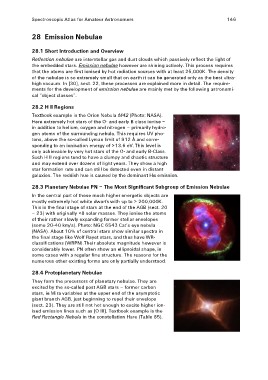
Textbook example is the Orion Nebula M42 (Photo: NASA).
Here extremely hot stars of the O- and early B class ionise –
in addition to helium, oxygen and nitrogen – primarily hydro-
gen atoms of the surrounding nebula. This requires UV pho-
tons, above the so-called Lyman limit of 912 Å and corre-
sponding to an ionisation energy of >13.6 eV. This level is
only achievable by very hot stars of the O- and early B-Class.
Such H II regions tend to have a clumpy and chaotic structure
and may extend over dozens of light years. They show a high
star formation rate and can still be detected even in distant
galaxies. The reddish hue is caused by the dominant Hα emission.

28.3 Planetary Nebulae PN – The Most Significant Subgroup of Emission Nebulae

In the central part of these much higher energetic objects are
mostly extremely hot white dwarfs with up to > 200,000K.
This is the final stage of stars at the end of the AGB (sect. 20
– 23) with originally <8 solar masses. They ionise the atoms
of their rather slowly expanding former stellar envelopes
(some 20-40 km/s). Photo: NGC 6543 Cat’s eye nebula
(NASA). About 10% of central stars show similar spectra in
the final stage like Wolf Rayet stars, and thus have WR-
classifications (WRPN).Their absolute magnitude however is
considerably lower. PN often show an ellipsoidal shape, in
some cases with a regular fine structure. The reasons for the
numerous other existing forms are only partially understood.

28.4 Protoplanetary Nebulae

They form the precursors of planetary nebulae. They are
excited by the so-called post AGB stars – former carbon
stars, ie Mira variables at the upper end of the asymptotic
giant branch AGB, just beginning to repel their envelops
(sect. 23). They are still not hot enough to excite higher ion-
ised emission lines such as [O III]. Textbook example is the
Red Rectangle Nebula in the constellation Hare (Table 85).

