


Page 35 - spectroscopic-atlas-5_0-english_Neat
P. 35
Spectroscopic Atlas for Amateur Astronomers 35
9.4 The WR-Phase in the Stellar Evolution
Crowther et al. has postulated three different evolutionary scenarios for WR stars, as a
function of the initial stellar mass ܯ, [234].
ܯ > 75 M O –> WNL –> LBV –> WNE –> WC –> SN Type Ic
40 M < ܯ < 75 M O –> LBV –> WNE –> WC –>WO –> SN Type Ic
25 M < ܯ < 40 M O –> LBV/RSG –> WNE –> WC –> SN Type Ib
According to [234] the evolutionary role of the LBV phase (sect. 11) is not yet clear and
may possibly be skipped in some cases. Unsure also appears in which cases a WO stage is
passed before the final SN.
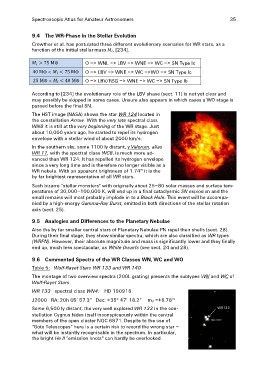
The HST image (NASA) shows the star WR 124 located in
the constellation Arrow. With the very late spectral class
WN8 it is still at the very beginning of the WR stage. Just
about 10,000 years ago, he started to repel its hydrogen
envelope with a stellar wind of about 2000 km/s.
In the southern sky, some 1100 ly distant, γ Velorum, alias
WR 11, with the spectral class WC8, is much more ad-
vanced than WR 124. It has repelled its hydrogen envelope
since a very long time and is therefore no longer visible as a
WR nebula. With an apparent brightness of 1.74m it is the
by far brightest representative of all WR stars.
Such bizarre “stellar monsters" with originally about 25–80 solar masses and surface tem-
peratures of 30,000–100,000 K, will end up in a final cataclysmic SN explosion and the
small remains will most probably implode in to a Black Hole. This event will be accompa-
nied by a high-energy Gamma-Ray Burst, emitted in both directions of the stellar rotation
axis (sect. 25).
9.5 Analogies and Differences to the Planetary Nebulae
Also the by far smaller central stars of Planetary Nebulae PN repel their shells (sect. 28).
During their final stage, they show similar spectra, which are also classified as WR types
(WRPN). However, their absolute magnitude and mass is significantly lower and they finally
end up, much less spectacular, as White Dwarfs (see sect. 24 and 28).
9.6 Commented Spectra of the WR Classes WN, WC and WO
Table 5: Wolf-Rayet Stars WR 133 and WR 140
The montage of two overview spectra (200L grating) presents the subtypes WN and WC of
Wolf-Rayet Stars.
WR 133 spectral class WN4: HD 190918
J2000 RA: 20h 05‘ 57.3‘‘ Dec: +35° 47‘ 18.2“ mV =+6.78m WR133
Some 6,500 ly distant, the very well explored WR 133 in the con-
stellation Cygnus hides itself inconspicuously within the central
members of the open cluster NGC 6871. Despite to the use of
"Goto Telescopes" here is a certain risk to record the wrong star –
what will be instantly recognisable in the spectrum. In particular,
the bright He II "emission knots" can hardly be overlooked.

