


Page 36 - spectroscopic-atlas-5_0-english_Neat
P. 36
Spectroscopic Atlas for Amateur Astronomers 36
WR 133 forms a spectroscopic binary (SB2) with an O9 l Supergiant in an orbital period of
about 112 days. Therefore, we see a composite spectrum, which is however clearly domi-
nated by the emission lines of the WR star (labelled red in Table 5). Striking here are the
numerous lines of differently high ionised nitrogen, responsible for the classification WN.
However one faint carbon emission shows up here, C IV at λ 5801-12 [230]. This spectral
feature is significantly weaker, compared to the WC type WR 140 (see below).
The very close-by O9 companion star generates here some absorptions of helium- and
some H-Balmer lines (labelled black in Table 5), as well as the sodium double line, which is
of interstellar origin [344]. In sect. 28.12 the same classified WR 7 is presented as ionising
source of NGC 2359, showing a "pure" WN 4 spectrum (see Table 88). The continuum is
here, in comparison to WR 140 (presented below), relatively intense. The strong He II
emission at λ 6560 poses a considerable risk to be misinterpreted as Hα line at λ 6562!
The most intense line here is clearly He II at λ 4686. The expansion velocity of the stellar
wind can be estimated from the FWHM values of the two intense He II emissions. If these
figures are put in to the Doppler formula and the results are finally corrected by the instru-
mental broadening [30], velocities of ݒ ≈ 1800 ݇݉/ ݏat λ 4686 and ݒ ≈ 1500 ݇݉/ ݏat λ
6560 are resulting. In the order of magnitude, these figures agree quite well with literature
values (ݒ < 2000 ݇݉/)ݏ. The spectrum was recorded with the 90 cm (36 inch) CEDES Cas-
segrain Telescope in Falera – exposure: 4x30 sec. The line identification is based amongst
others on [230] [231] [232] [233] [344].
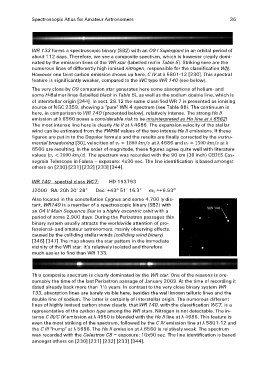
WR 140 spectral class WC7: HD 193793 WR 140
J2000 RA: 20h 20‘ 28” Dec: +43° 51‘ 16.3“ mV =+6.93m
Also located in the constellation Cygnus and some 4,700 ly dis-
tant, WR140 is a member of a spectroscopic binary (SB2) with
an O4 V Main Sequence Star in a highly excentric orbit with a
period of some 2,900 days. During the Periastron passages this
binary system usually attracts the worldwide attention of pro-
fessional- and amateur astronomers, mainly observing effects,
caused by the colliding stellar winds (colliding wind binary)
[346] [347].The map shows the star pattern in the immediate
vicinity of the WR star. It’s relatively isolated and therefore
much easier to find than WR 133.
This composite spectrum is clearly dominated by the WR star. One of the reasons is pre-
sumably the time of the last Periastron passage of January 2009. At the time of recording it
dated already back more than 1½ years. In contrast to the very close binary system WR
133, absorption lines are barely visible here, besides the well known telluric lines and the
double line of sodium. The latter is certainly of interstellar origin. The numerous different
lines of highly ionised carbon show clearly, that WR 140, with the classification WC7, is a
representative of the carbon type among the WR stars. Nitrogen is not detectable. The in-
tense C III/C IV emission at λ 4650 is blended with the He II line at λ 4686. This feature is
even the most striking of the spectrum, followed by the C IV emission line at λ 5801-12 and
the C lll "hump" at λ 5696. The He II emission at λ 6560 is relatively weak. The spectrum
was recorded with the Celestron C8 – exposure: 10x90 sec. The line identification is based
amongst others on [230] [231] [232] [233] [344].

