


Page 37 - spectroscopic-atlas-5_0-english_Neat
P. 37
Spectroscopic Atlas for Amateur Astronomers 37
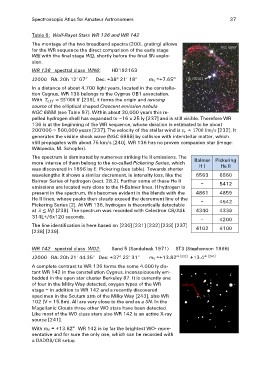
Table 6: Wolf-Rayet Stars WR 136 and WR 142
The montage of the two broadband spectra (200L grating) allows
for the WR sequence the direct comparison of the early stage
WN with the final stage WO, shortly before the final SN explo-
sion.
WR 136 spectral class WN6: HD192163
J2000 RA: 20h 12‘ 07” Dec: +38° 21‘ 18“ mV =+7.65m
In a distance of about 4,700 light years, located in the constella-
tion Cygnus, WR 136 belongs to the Cygnus OB1 association.
With ܶ ≈ 55ᇱ000 [ ܭ239], it forms the origin and ionising
source of the elliptical shaped Crescent emission nebula
NGC 6888 (see Table 87). Within about 30,000 years this re-
pelled hydrogen shell has expanded to ~16 x 25 ly [237] and is still visible. Therefore WR
136 is at the beginning of the WR sequence, whose duration is estimated to be about
200'000 – 500,000 years [237]. The velocity of the stellar wind is ݒ ≈ 1700 ݇݉/[ ݏ232]. It
generates the visible shock wave (NGC 6888) by collision with interstellar matter, which
still propagates with about 75 km/s [240]. WR 136 has no proven companion star (image:
Wikipedia, M. Schopfer).
The spectrum is dominated by numerous striking He II emissions. The Balmer Pickering
more intense of them belong to the so-called Pickering Series, which H I He II
was discovered in 1896 by E. Pickering (see table). Towards shorter
wavelengths it shows a similar decrement, ie intensity loss, like the 6563 6560
Balmer Series of hydrogen (sect. 28.2). Further some of these He II – 5412
emissions are located very close to the H-Balmer lines. If hydrogen is
present in the spectrum, this becomes evident in the blends with the 4861 4859
He II lines, whose peaks then clearly exceed the decrement line of the – 4542
Pickering Series [2]. At WR 136, hydrogen is theoretically detectable
at ߣ [ ߚܪ239]. The spectrum was recorded with Celestron C8/Atik 4340 4339
314L+/6x120 seconds. – 4200
The line identification is here based on [230] [231] [232] [233] [237] 4102 4100
[238] [239].
WR 142 spectral class WO2: Sand 5 (Sanduleak 1971) ST3 (Stephenson 1966)
J2000 RA: 20h 21‘ 44.35” Dec: +37° 22‘ 31“ mV =+13.82m [232] +13.4m [241]
A complete contrast to WR 136 forms the some 4,000 ly dis- WR142
tant WR 142 in the constellation Cygnus, inconspicuously em-
bedded in the open star cluster Berkeley 87. It is currently one
of four in the Milky Way detected, oxygen types of the WR
stage – in addition to WR 142 and a recently discovered
specimen in the Scutum arm of the Milky Way [243], also WR
102 (V = 15.8m). All are very close to the end as a SN. In the
Magellanic Clouds three other WO stars have been detected.
Like most of the WO class stars also WR 142 is an active X-ray
source [241].
With mV = +13.82m WR 142 is by far the brightest WO- repre-
sentative and for sure the only one, which can be recorded with
a DADOS/C8 setup.

