


Page 42 - spectroscopic-atlas-5_0-english_Neat
P. 42
Spectroscopic Atlas for Amateur Astronomers  42

K-Linie Ca ll

10.4 Commented Spectra

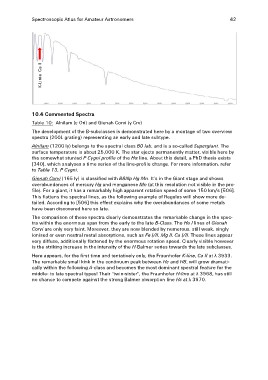
Table 10: Alnilam (ε Ori) and Gienah Corvi (γ Crv)

The development of the B-subclasses is demonstrated here by a montage of two overview
spectra (200L grating) representing an early and late subtype.

Alnilam (1200 ly) belongs to the spectral class B0 Iab, and is a so-called Supergiant. The
surface temperature is about 25,000 K. The star ejects permanently matter, visible here by
the somewhat stunted P Cygni profile of the Hα line. About this detail, a PhD thesis exists
[340], which analyses a time series of the line-profile change. For more information, refer
to Table 13, P Cygni.

Gienah Corvi (165 ly) is classified with B8lllp Hg Mn. It’s in the Giant stage and shows
overabundances of mercury Hg and manganese Mn (at this resolution not visible in the pro-
file). For a giant, it has a remarkably high apparent rotation speed of some 150 km/s [506].
This flattens the spectral lines, as the following example of Regulus will show more de-
tailed. According to [506] this effect explains why the overabundances of some metals
have been discovered here so late.

The comparison of these spectra clearly demonstrates the remarkable change in the spec-
tra within the enormous span from the early to the late B-Class. The He I lines of Gienah
Corvi are only very faint. Moreover, they are now blended by numerous, still weak, singly
ionised or even neutral metal absorptions, such as Fe I/II, Mg II, Ca I/II. These lines appear
very diffuse, additionally flattened by the enormous rotation speed. Clearly visible however
is the striking increase in the intensity of the H-Balmer series towards the late subclasses.

Here appears, for the first time and tentatively only, the Fraunhofer K-line, Ca II at λ 3933.
The remarkable small kink in the continuum peak between Hε and H8, will grow dramati-
cally within the following A-class and becomes the most dominant spectral feature for the
middle- to late spectral types! Their "twin-sister", the Fraunhofer H-line at λ 3968, has still
no chance to compete against the strong Balmer absorption line Hε at λ 3970.

