


Page 44 - spectroscopic-atlas-5_0-english_Neat
P. 44
Spectroscopic Atlas for Amateur Astronomers  44

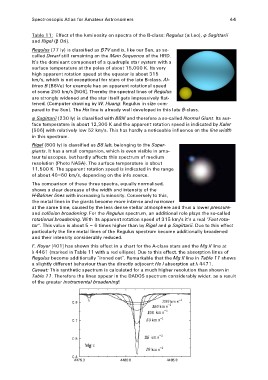
Table 11: Effect of the luminosity on spectra of the B-class: Regulus (α Leo), φ Sagittarii
and Rigel (β Ori).

Regulus (77 ly) is classified as B7V and is, like our Sun, as so-
called Dwarf still remaining on the Main Sequence of the HRD.
It’s the dominant component of a quadruple star system with a
surface temperature at the poles of about 15,000 K. Its very
high apparent rotation speed at the equator is about 315
km/s, which is not exceptional for stars of the late B-class. Al-
bireo B (B8Ve) for example has an apparent rotational speed
of some 250 km/s [506]. Thereby the spectral lines of Regulus
are strongly widened and the star itself gets impressively flat-
tened. (Computer drawing by W. Huang: Regulus in size com-
pared to the Sun). The Hα line is already well developed in this late B-class.

φ Sagittarii (230 ly) is classified with B8lll and therefore a so-called Normal Giant. Its sur-
face temperature is about 12,300 K and the apparent rotation speed is indicated by Kaler
[506] with relatively low 52 km/s. This has hardly a noticeable influence on the line width
in this spectrum.

Rigel (800 ly) is classified as B8 lab, belonging to the Super-
giants. It has a small companion, which is even visible in ama-
teur telescopes, but hardly affects this spectrum of medium
resolution (Photo NASA). The surface temperature is about
11,500 K. The apparent rotation speed is indicated in the range
of about 40–60 km/s, depending on the info source.

The comparison of these three spectra, equally normalised,
shows a clear decrease of the width and intensity of the
H-Balmer lines with increasing luminosity. Conversely to this,
the metal lines in the giants become more intense and narrower
at the same time, caused by the less dense stellar atmosphere and thus a lower pressure-
and collision broadening. For the Regulus spectrum, an additional role plays the so-called
rotational broadening. With its apparent rotation speed of 315 km/s it’s a real “Fast rota-
tor“. This value is about 5 – 6 times higher than by Rigel and φ Sagittarii. Due to this effect
particularly the fine metal lines of the Regulus spectrum become additionally broadened
and their intensity considerably reduced.

F. Royer [401] has shown this effect in a chart for the A-class stars and the Mg II line at
λ 4481 (marked in Table 11 with a red ellipse). Due to this effect, the absorption lines of
Regulus become additionally “ironed out”. Remarkable that the Mg II line in Table 11 shows
a slightly different behaviour than the directly adjacent He l absorption at λ 4471.
Caveat: This synthetic spectrum is calculated for a much higher resolution than shown in
Table 11. Therefore the lines appear in the DADOS spectrum considerably wider, as a result
of the greater instrumental broadening!

