


Page 59 - spectroscopic-atlas-5_0-english_Neat
P. 59
Spectroscopic Atlas for Amateur Astronomers 59
14 PMS Protostars
14.1 Overview
These objects represent the stellar birth phase. These so-called YSO (Young Stellar Objects)
are formed from contracting gas and dust clouds. Due to this gravitational process the tem-
perature in the center rises until the onset of the hydrogen fusion. Finally the star begins to
shine. From now on, within the rough time frame of several hundred thousand to millions of
years, it approaches from top, downward to the main sequence of
the HRD. Therefore, these objects are also called PMS stars (Pre-
Main Sequence) [2]. The highly irregular optical brightness variations
proof, that the PMS stars are still very unstable. In a later phase
planets are formed from the residual, protoplanetary disk material.
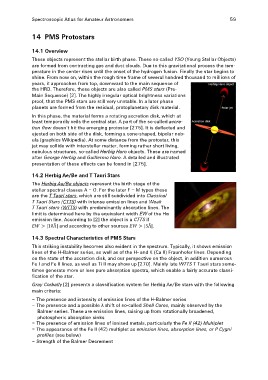
In this phase, the material forms a rotating accretion disk, which at
least temporarily veils the central star. A part of the so-called accre-
tion flow doesn’t hit the emerging protostar [275]. It is deflected and
ejected on both side of the disk, forming a cone-shaped, bipolar neb-
ula (graphics Wikipedia). At some distance from the protostar, this
jet may collide with interstellar matter, forming rather short living,
nebulous structures, so-called Herbig Haro objects. These are named
after George Herbig and Guillermo Haro. A detailed and illustrated
presentation of these effects can be found in [275].
14.2 Herbig Ae/Be and T Tauri Stars
The Herbig Ae/Be objects represent the birth stage of the
stellar spectral classes A – O. For the later F – M types these
are the T Tauri stars, which are still subdivided into Classical
T Tauri Stars (CTTS) with intense emission lines and Weak
T Tauri stars (WTTS) with predominantly absorption lines. The
limit is determined here by the equivalent width EW of the Hα
emission line. According to [2] the object is a CTTS if
| > ܹܧ10Å| and according to other sources | > ܹܧ5Å|.
14.3 Spectral Characteristics of PMS Stars
This striking instability becomes also evident in the spectrum. Typically, it shows emission
lines of the H-Balmer series, as well as of the H- and K (Ca II) Fraunhofer lines. Depending
on the state of the accretion disk, and our perspective on the object, in addition numerous
Fe I and Fe II lines, as well as Ti II may show up [270]. Mainly late WTTS T Tauri stars some-
times generate more or less pure absorption spectra, which enable a fairly accurate classi-
fication of the star.
Gray Corbally [2] presents a classification system for Herbig Ae/Be stars with the following
main criteria:
– The presence and intensity of emission lines of the H-Balmer series
– The presence and a possible λ shift of so-called Shell Cores, mainly observed by the
Balmer series. These are emission lines, raising up from rotationally broadened,
photospheric absorption sinks.
– The presence of emission lines of ionised metals, particularly the Fe II (42) Multiplet
– The appearance of the Fe II (42) multiplet as emission lines, absorption lines, or P Cygni
profiles (see below)
– Strength of the Balmer Decrement

