


Page 56 - spectroscopic-atlas-5_0-english_Neat
P. 56
Spectroscopic Atlas for Amateur Astronomers                                                       56

13 Be Shell Stars

13.1 Overview

During the Be phase a star can pass in some cases also the extreme shell stage. In this
case it forms not only a disk, but rather a large scale, low density shell (“pseudo photo-
sphere” [2]), which has similar characteristics like the photosphere of the Supergiants with
a luminosity class of approximately I-II.

13.2 Spectral Characteristics of Be Shell Stars

Accordingly, only few emission lines are showing up here, however much more very narrow
but strikingly intense absorption lines with low FWHM values. Prototype for this star cate-
gory is ζ Tauri. Also 28 Tauri (Plejone) is undergoing this extreme shell stage from time to
time (see sect. 27.6!). Sometimes the suffix pe is added to the spectral classification of
such stars.

13.3 Commented Spectra

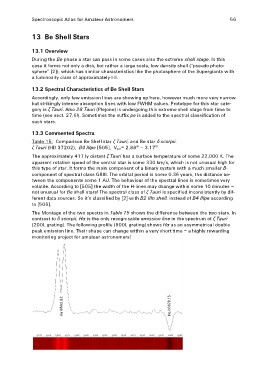
Table 15: Comparison Be Shell star ζ Tauri, and Be star δ scorpii.
ζ Tauri (HD 37202), B4 IIIpe [505], Vvar= 2.88m – 3.17m

The approximately 417 ly distant ζ Tauri has a surface temperature of some 22,000 K. The
apparent rotation speed of the central star is some 330 km/s, which is not unusual high for
this type of star. It forms the main component of a binary system with a much smaller B-
component of spectral class G8III. The orbital period is some 0.36 years, the distance be-
tween the components some 1 AU. The behaviour of the spectral lines is sometimes very
volatile. According to [505] the width of the H-lines may change within some 10 minutes –
not unusual for Be shell stars! The spectral class of ζ Tauri is specified inconsistently by dif-
ferent data sources. So it’s classified by [2] with B2 IIIn shell, instead of B4 IIIpe according
to [505].

The Montage of the two spectra in Table 15 shows the difference between the two stars. In
contrast to δ scorpii, Hα is the only recognisable emission line in the spectrum of ζ Tauri
(200L grating). The following profile (900L grating) shows Hα as an asymmetrical double
peak emission line. Their shape can change within a very short time – a highly rewarding
monitoring project for amateur astronomers!

Hα 6562.82
                                                                                    He I 6678.15

