


Page 69 - spectroscopic-atlas-5_0-english_Neat
P. 69
Spectroscopic Atlas for Amateur Astronomers 69
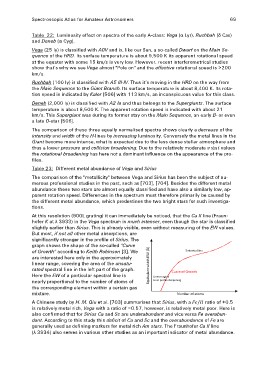
Table 22: Luminosity effect on spectra of the early A-class: Vega (α Lyr), Ruchbah (δ Cas)
and Deneb (α Cyg).
Vega (25 ly) is classified with A0V and is, like our Sun, a so-called Dwarf on the Main Se-
quence of the HRD. Its surface temperature is about 9,500 K its apparent rotational speed
at the equator with some 15 km/s is very low. However, recent interferometrical studies
show that’s why we see Vega almost "Pole on" and the effective rotational speed is >200
km/s.
Ruchbah (100 ly) is classified with A5 III-IV. Thus it’s moving in the HRD on the way from
the Main Sequence to the Giant Branch. Its surface temperature is about 8,400 K. Its rota-
tion speed is indicated by Kaler [506] with 113 km/s, an inconspicuous value for this class.
Deneb (2,000 ly) is classified with A2 Ia and thus belongs to the Supergiants. The surface
temperature is about 8,500 K. The apparent rotation speed is indicated with about 21
km/s. This Supergiant was during its former stay on the Main Sequence, an early B- or even
a late O-star [506].
The comparison of these three equally normalised spectra shows clearly a decrease of the
intensity and width of the H-lines by increasing luminosity. Conversely the metal lines in the
Giant become more intense, what is expected due to the less dense stellar atmosphere and
thus a lower pressure and collision broadening. Due to the relatively moderate ݒsin ݅ values
the rotational broadening has here not a dominant influence on the appearance of the pro-
files.
Table 23: Different metal abundance of Vega and Sirius
The comparison of the "metallicity" between Vega and Sirius has been the subject of nu-
merous professional studies in the past, such as [703], [704]. Besides the different metal
abundance these two stars are almost equally classified and have also a similarly low, ap-
parent rotation speed. Differences in the spectrum must therefore primarily be caused by
the different metal abundance, which predestines the two bright stars for such investiga-
tions.
At this resolution (900L grating) it can immediately be noticed, that the Ca II line (Fraun-
hofer K at λ 3933) in the Vega spectrum is much intenser, even though the star is classified
slightly earlier than Sirius. This is already visible, even without measuring of the EW values.
But most, if not all other metal absorptions, are
significantly stronger in the profile of Sirius. The
graph shows the shape of the so-called "Curve Equivalent width EW [Å]
of Growth" according to Keith Robinson [3]. We Saturated line
are interested here only in the approximately
linear range, covering the area of the unsatu-
rated spectral line in the left part of the graph. Curve of Growth
Here the EW of a particular spectral line is
nearly proportional to the number of atoms of Linear region
Linie profile deepening
the corresponding element within a certain gas
mixture. Number of atoms
A Chinese study by H. M. Qiu et al. [703] summarises that Sirius, with a ݁ܨ/ ܪratio of +0.5
is relatively metal rich, Vega with a ratio of –0.57, however, is relatively metal poor. Here is
also confirmed that for Sirius Ca and Sc are underabundant and vice versa Fe overabun-
dant. According to this study this deficit of Ca and Sc and the overabundance of Fe are
generally used as defining markers for metal rich Am stars. The Fraunhofer Ca II line
(λ 3934) also serves in various other studies as an important indicator of metal abundance.

