


Page 78 - spectroscopic-atlas-5_0-english_Neat
P. 78
Spectroscopic Atlas for Amateur Astronomers  78

in the violet area, overprinting here the H8 and H9 Balmer lines beyond recognition. In
highly resolved spectra now finer absorption bands of carbon monoxide CO appear. The in-

tensity maximum of the real continuum shifts now to the green part of the visible spectrum,
hence the evolution has optimised our eyes to this wavelength domain (Sun G2V). The
graph shows the theoretical continuum for a synthetic G5 V standard star
(Vspec/Tools/Library). Highlighted with a red arrow is here the area on the violet side of the
H+K Fraunhofer lines, where strong molecular CN and CH absorption bands overprint the
former H8- and H9-Balmer lines.

17.4 Commented Spectra

Table 40: Muphrid (η Boo) und Vindemiatrix (ε Vir)

The development of the G-subclasses is demonstrated here by two superposed overview
spectra (200L grating) representing an early and late subtype.

Muphrid (37 ly) with G0 IV has already moved away from the Main Sequence towards the
Giant Branch in the HRD. Of all naked eye visible stars in the northern sky, it’s the closest
"class neighbour" to the Sun (G2V). Its surface temperature is about 6,100 K, i.e. slightly
hotter than our central star – hence the earlier classification. It’s a part of a spectroscopic
binary. The B-component however, is so small that, in contrast to Spica, no splitting of the
spectral lines can be observed (SB1 system). Muphrid is classified by several sources as
above average metal rich. Nevertheless, the suffix m is missing here in the classification.

Vindemiatrix (103 ly) with G8 lllab is a late representative of the G-class and has already
developed to the Giant stage. Its apparent rotation speed is <17km/s [505] what is usual
for this class. According to [506] Vindemiatrix was formerly a B-class Main Sequence Star.

The comparison of these spectra demonstrates mainly the intensity loss of the H-Balmer
lines, well visible by the Hβ line. The profile of Vindemiatrix shows also a massively
shrunken Hγ line which is now difficult to identify, particularly besides the now dominant
G-band (CH). Otherwise, no spectacular changes can be seen. However in highly resolved
spectra, significant intensity differences of individual lines would be detectable, particularly
within the blends.

Table 41 and 42: The Sun, spectra recorded from reflected daylight.

Our central star (G2V), with a surface temperature of approx. 5,800
K, is a normal Dwarf on the Main Sequence. On these tables the
Sun is documented with an overview spectrum (200L grating) and
three higher-resolved profiles in the blue, green and red domain
(900L grating). The Sun has a very low rotation speed of just below
2 km/s, which is usual for middle and late spectral types. The in-
creased thickness of the convective shell generates strong mag-
netic fields with a considerable breaking effect on the stellar rota-
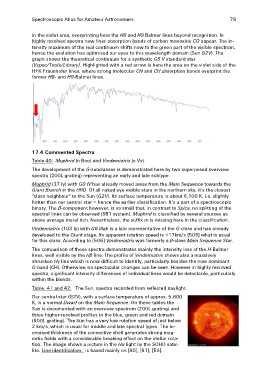
tion. The image shows a picture in the Hα light by the SOHO satel-
lite. Line identification: is based mainly on [80], [81], [59].

