


Page 82 - spectroscopic-atlas-5_0-english_Neat
P. 82
Spectroscopic Atlas for Amateur Astronomers                               82

18 Spectral Class K

18.1 Overview

The stars of the orange yellow shining K-class includes familiar names such as Pollux, Al-
debaran, Arcturus, Hamal, Alphard, as well as the lighter, yellow bright orange component
of the famous double star Albireo A (K3 II).

18.2 Parameters of the Early to Late K-Class Stars

The following table shows the data exclusively for the Main Sequence Stars of the K-class,
compared to the Sun ( ) and according to [701].

Mass       Stay on main  Temperature         Radius       Luminosity L/L
M/M        sequence [y]  photosphere [K]     R/R            0.42 – 0.10

0.8 – 0.6  >20bn          5,250 – 4,000       0.8 – 0.65

Striking is also here the percental low mass range, which is covered by this class. All
K-class dwarfs stay longer on the Main Sequence than the estimated age of the universe of
some 13.7 billion years. This means that in the entire universe, not a single star of this
class is migrated to the Giant Branch! The luminosity of the K- Main Sequence Stars is so
low that they are only visible at relatively short distances. Therefore, all above listed "high-
lights" of this class are located on the Giant Branch. These massive stars were classified
much earlier during their former stay on the Main Sequence. Their parameters are therefore
far outside of the table values above. Here they spend only a relatively short time before
they explode as a SN or end up as White Dwarfs.

Only a few real K- Main Sequence Stars are visible with the
naked eye. In the northern sky the best-known is probably the
only 11 ly distant binary 61 Cygni, with a total apparent
brightness of just 4.8m and the spectral classes K5V and K7V
(see Table 52). The Wikipedia graphic shows the size of the
two K-class components compared to the Sun.

18.3 Spectral Characteristics of the K-Class

The temperature of this class is considerably lower than in the G-category, but still as high
as within the solar sunspots. Correspondingly, the spectra of the early K-class look still very
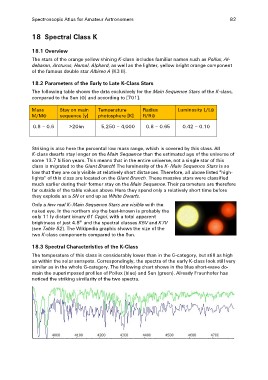
similar as in the whole G-category. The following chart shows in the blue short-wave do-
main the superimposed profiles of Pollux (blue) and Sun (green). Already Fraunhofer has
noticed the striking similarity of the two spectra.

