


Page 13 - Super Earth Encyclopedia
P. 13
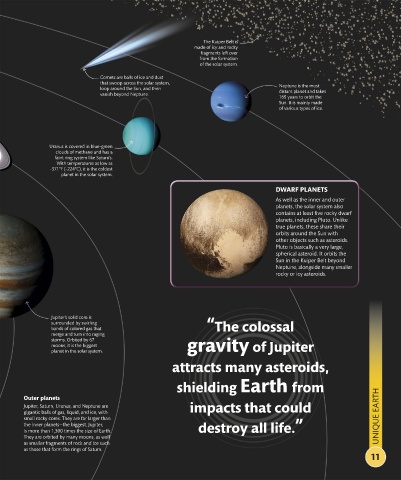
The Kuiper Belt is
                                                                      made of icy and rocky
                                                                         fragments left over
                                                                        from the formation
                                                                        of the solar system.
                                     Comets are balls of ice and dust
                                     that swoop across the solar system,                            Neptune is the most
                                     loop around the Sun, and then                                  distant planet and takes
                                     vanish beyond Neptune.
                                                                                                    165 years to orbit the
                                                                                                    Sun. It is mainly made
                                                                                                    of various types of ice.


                   Uranus is covered in blue-green
                     clouds of methane and has a
                     faint ring system like Saturn’s.
                     With temperatures as low as
                   -371°F (-224°C), it is the coldest
                       planet in the solar system.

                                                                                                   DWARF PLANETS

                                                                                                   As well as the inner and outer
                                                                                                   planets, the solar system also
                                                                                                   contains at least five rocky dwarf
                                                                                                   planets, including Pluto. Unlike
                                                                                                   true planets, these share their
                                                                                                   orbits around the Sun with
                                                                                                   other objects such as asteroids.
                                                                                                   Pluto is basically a very large,
                                                                                                   spherical asteroid. It orbits the
                                                                                                   Sun in the Kuiper Belt beyond
                                                                                                   Neptune, alongside many smaller
                                                                                                   rocky or icy asteroids.


                   Jupiter’s solid core is
                   surrounded by swirling                                  “The colossal
                   bands of colored gas that
                   merge and turn into raging
                   storms. Orbited by 67
                   moons, it is the biggest                         gravity of Jupiter
                   planet in the solar system.

                                                              attracts many asteroids,


                                                                shielding Earth from


          Outer planets
          Jupiter, Saturn, Uranus, and Neptune are                   impacts that could
          gigantic balls of gas, liquid, and ice, with
          small rocky cores. They are far larger than                                                                                   UNIQUE EARTH
          the inner planets—the biggest, Jupiter,                       destroy all life.”
          is more than 1,300 times the size of Earth.
          They are orbited by many moons, as well
          as smaller fragments of rock and ice such
          as those that form the rings of Saturn.
                                                                                                                                     11


   US_010-011_Earth_in_space.indd   11                                                                                               01/03/17   1:38 pm

