


Page 17 - Super Earth Encyclopedia
P. 17
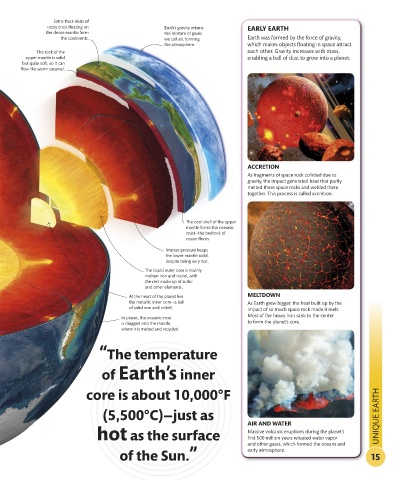
Extra-thick slabs of
                  rocky crust floating on                   Earth’s gravity retains      EARLY EARTH
                 the dense mantle form                      the mixture of gases
                       the continents.                      we call air, forming         Earth was formed by the force of gravity,
                                                            the atmosphere.              which makes objects floating in space attract
              The rock of the                                                            each other. Gravity increases with mass,
          upper mantle is solid                                                          enabling a ball of dust to grow into a planet.
         but quite soft, so it can
        flow like warm caramel.


                                                                                         ACCRETION
                                                                                         As fragments of space rock collided due to
                                                                                         gravity, the impact generated heat that partly
                                                                                         melted these space rocks and welded them
                                                                                         together. This process is called accretion.


                                                                   The cool shell of the upper
                                                                   mantle forms the oceanic
                                                                   crust—the bedrock of
                                                                   ocean floors.

                                                            Intense pressure keeps
                                                            the lower mantle solid,
                                                            despite being very hot.
                                                     The liquid outer core is mainly
                                                     molten iron and nickel, with
                                                     the rest made up of sulfur
                                                     and other elements.
                                               At the heart of the planet lies           MELTDOWN
                                               the metallic inner core—a ball            As Earth grew bigger, the heat built up by the
                                               of solid iron and nickel.                 impact of so much space rock made it melt.
                                            In places, the oceanic crust                 Most of the heavy iron sank to the center
                                            is dragged into the mantle,                  to form the planet’s core.
                                            where it is melted and recycled.


                                    “The temperature


                                     of Earth’s inner


                                core is about 10,000°F


                                      (5,500°C)—just as                                                                                 UNIQUE EARTH

                                                                                         AIR AND WATER
                                    hot as the surface                                   Massive volcanic eruptions during the planet’s
                                                                                         first 500 million years released water vapor
                                            of the Sun.”                                 and other gases, which formed the oceans and   15
                                                                                         early atmosphere.


   US_014-015_Layered_Planet.indd   15                                                                                               01/03/17   4:25 pm

