


Page 156 - Super Earth Encyclopedia
P. 156
GRAND SLAM


                     MICROBURST


                  Strong updrafts of warm, moist air build up giant
                  storm clouds. But as the warm air rises through the
                  core of the cloud, cold air sinks through other parts of
                  the cloud where there is no rising airflow. Rain and hail
                  can chill the sinking air even further, making it heavier
                  so that it falls from the sky faster and faster, like an
                  avalanche. This is called a downburst, or microburst.
                  When it slams into the ground, the cold air rushes out
                  from the point of impact at high speed in powerful winds
                  that can cause serious damage. Microbursts can be so
                  violent that they are mistaken for tornadoes.


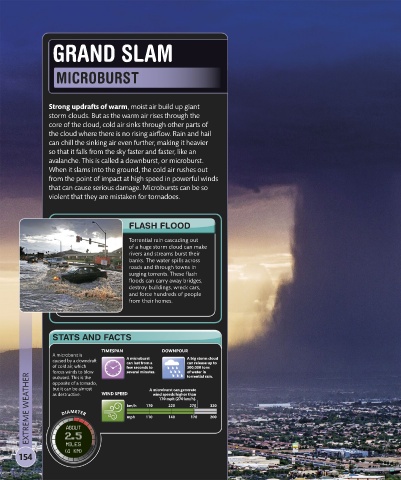
                                               FLASH FLOOD


                                               Torrential rain cascading out
                                               of a huge storm cloud can make
                                               rivers and streams burst their
                                               banks. The water spills across
                                               roads and through towns in
                                               surging torrents. These flash
                                               floods can carry away bridges,
                                               destroy buildings, wreck cars,
                                               and force hundreds of people
                                               from their homes.


                    STATS AND FACTS

                                     TIMESPAN              DOWNPOUR
                    A microburst is
                    caused by a downdraft     A microburst          A big storm cloud
                                                                    can release up to
                                              can last from a
                    of cold air, which        few seconds to        300,000 tons
                    forces winds to blow
                                                                    of water in
                                              several minutes.
           EXTREME WEATHER   but it can be almost    WIND SPEED km/h  170 wind speeds higher than   320
                                                                    torrential rain.
                    outward. This is the
                    opposite of a tornado,
                                                      A microburst can generate
                    as destructive.
                                                          170 mph (270 km/h).
                                                             220
                                                                     270
                       DIAMETER
                                                                     170
                                                             140
                                                                            200
                                                     110
                                              mph
                         ABOUT
                        2.5
                        MILES
                        (4 KM)
        154

   US_154-155_Microburst.indd   154                                                                                                  01/03/17   1:39 pm

