


Page 43 - Super Earth Encyclopedia
P. 43
CREEPING CRUST


                                                                    SAN ANDREAS FAULT


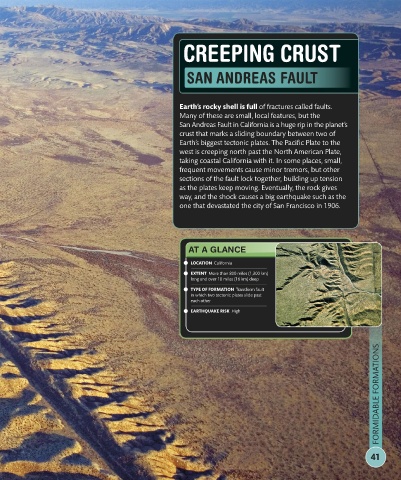
                                                                 Earth’s rocky shell is full of fractures called faults.
                                                                 Many of these are small, local features, but the
                                                                 San Andreas Fault in California is a huge rip in the planet’s
                                                                 crust that marks a sliding boundary between two of
                                                                 Earth’s biggest tectonic plates. The Pacific Plate to the
                                                                 west is creeping north past the North American Plate,
                                                                 taking coastal California with it. In some places, small,
                                                                 frequent movements cause minor tremors, but other
                                                                 sections of the fault lock together, building up tension
                                                                 as the plates keep moving. Eventually, the rock gives
                                                                 way, and the shock causes a big earthquake such as the
                                                                 one that devastated the city of San Francisco in 1906.


                                                                    AT A GLANCE

                                                                  •  LOCATION  California
                                                                  •  EXTENT  More than 800 miles (1,300 km)
                                                                     long and over 10 miles (16 km) deep
                                                                  •  TYPE OF FORMATION  Transform fault
                                                                     in which two tectonic plates slide past
                                                                     each other
                                                                  •  EARTHQUAKE RISK  High


                                                                                                                                     41 FORMIDABLE FORMATIONS


   US_040-041_San_Andreas_Fault.indd   41                                                                                           01/03/17   11:21 am

