


Page 69 - 100 Events That Made History
P. 69
Crisis in Cuba
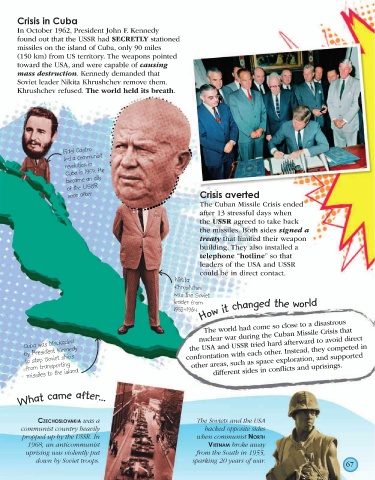
       In October 1962, President John F. Kennedy
       found out that the USSR had SECRETLY stationed
       missiles on the island of Cuba, only 90 miles
       (150 km) from US territory. The weapons pointed
       toward the USA, and were capable of causing
       mass destruction. Kennedy demanded that
       Soviet leader Nikita Khrushchev remove them.
       Khrushchev refused. The world held its breath.


                      Fidel Castro
                      led a communist
                      revolution in
                      Cuba in 1959. He
                       became an ally
                       of the USSR
                       soon after.                                Crisis averted
                                                                  The Cuban Missile Crisis ended
                                                                  after 13 stressful days when
                                                                  the USSR agreed to take back
                                                                  the missiles. Both sides signed a
                                                                  treaty that limited their weapon
                                                                  building. They also installed a
                                                                  telephone “hotline” so that
                                                                  leaders of the USA and USSR
                                                                  could be in direct contact.
                                                          Nikita
                                                          Khrushchev
                                                          was the Soviet
                                                          leader from
                                                          1953–1964. How it changed the world
                                                                    The world had come so close to a disastrous
                                                                  nuclear war during the Cuban Missile Crisis that
         Cuba was blockaded                                    the USA and USSR tried hard afterward to avoid direct
         by President Kennedy                                 confrontation with each other. Instead, they competed in
         to stop Soviet ships                                  other areas, such as space exploration, and supported
          from transporting                                            different sides in conflicts and uprisings.
          missiles to the island.


       What came after…


             CZECHOSLOVAKIA was a                                The Soviets and the USA
        communist country heavily                                   backed opposite sides
        propped up by the USSR. In                               when communist NORTH
          1968, an anticommunist                                     VIETNAM broke away
         uprising was violently put                              from the South in 1955,
             down by Soviet troops.                             sparking 20 years of war.
                                                                                                                  67

