


Page 79 - 100 Events That Made History
P. 79
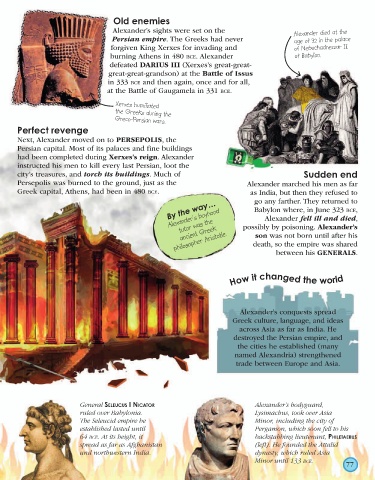
Old enemies
                                      Alexander’s sights were set on the                         Alexander died at the
                                      Persian empire. The Greeks had never                       age of 32 in the palace
                                     forgiven King Xerxes for invading and                       of Nebuchadnezzar II
                                     burning Athens in 480 BCE. Alexander                        of Babylon.
                                     defeated DARIUS III (Xerxes’s great-great-
                                    great-great-grandson) at the Battle of Issus
                                    in 333 BCE and then again, once and for all,
                                    at the Battle of Gaugamela in 331 BCE.

                                       Xerxes humiliated
                                       the Greeks during the
                                       Greco-Persian wars.
       Perfect revenge
       Next, Alexander moved on to PERSEPOLIS, the
       Persian capital. Most of its palaces and fine buildings
       had been completed during Xerxes’s reign. Alexander
       instructed his men to kill every last Persian, loot the
       city’s treasures, and torch its buildings. Much of                                           Sudden end
       Persepolis was burned to the ground, just as the                           Alexander marched his men as far
       Greek capital, Athens, had been in 480 BCE.                                 as India, but then they refused to

                                                        By the way…                 go any farther. They returned to
                                                                                    Babylon where, in June 323 BCE,
                                                        Alexander’s boyhood
                                                                                       Alexander fell ill and died,
                                                            tutor was the
                                                            ancient Greek
                                                          philosopher Aristotle.  possibly by poisoning. Alexander’s
                                                                                    son was not born until after his
                                                                                    death, so the empire was shared
                                                                                           between his GENERALS.


                                                                            How it changed the world


                                                                               Alexander’s conquests spread
                                                                             Greek culture, language, and ideas
                                                                               across Asia as far as India. He
                                                                             destroyed the Persian empire, and
                                                                               the cities he established (many
                                                                              named Alexandria) strengthened
                                                                              trade between Europe and Asia.


                           General SELEUCUS I NICATOR                               Alexander’s bodyguard,
                           ruled over Babylonia.                                    Lysimachus, took over Asia
                           The Seleucid empire he                                   Minor, including the city of
                           established lasted until                                 Pergamon, which soon fell to his
                           64 BCE. At its height, it                                backstabbing lieutenant, PHILETAERUS
                           spread as far as Afghanistan                             (left). He founded the Attalid
                           and northwestern India.                                  dynasty, which ruled Asia
                                                                                    Minor until 133 BCE.
                                                                                                                  77

