


Page 66 - DINOSOUR ATLAS
P. 66
Lufeng Basin


        in The early jurassic, about 200 million years ago, a shallow inland sea
        covered much of southern China. Rivers flowed into it, and on their
        floodplains lived prosauropods, a group of large plant-eaters that                            Chuxiong    Lufeng   Kunming
                                                                                                                  Basin
        came before the sauropods. It was the discovery of one of these,
        Lufengosaurus, that alerted the world’s paleontologists to the                         Y U N N A N                 Dian Chi
        importance of the Lufeng Basin rocks, where red-colored
        sandstones, mudstones, and shales had built up to a depth of
        3,280 ft (1,000 m). About 12 Early Jurassic dinosaur species
        have been found here, which has led to the region becoming                                                            Fuxian Hu
        known as China’s “dinosaur homeland.”                                                                              Yuxi

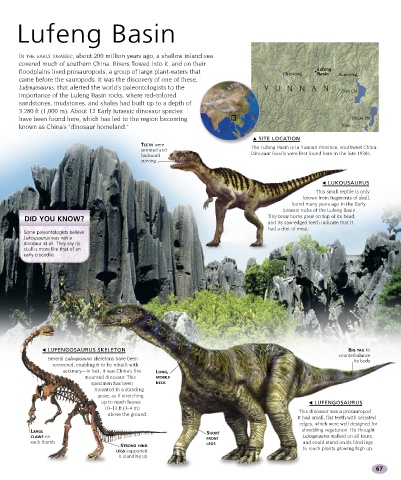
                                                                                           u SIte locAtIon
                                                   teetH were                              The Lufeng Basin is in Yunnan Province, southwest China.
                                                   serrated and
                                                   backward                                Dinosaur fossils were first found here in the late 1930s.
                                                   curving


                                                                                                                    , lUkoUSAUrUS
                                                                                                                  This small reptile is only
                                                                                                             known from fragments of skull,
                                                                                                         found many years ago in the Early
                                                                                                      Jurassic rocks of the Lufeng Basin.
          did you know?                                                                         Tiny brow horns grew on top of its head,
                                                                                                and its saw-edged teeth indicate that it
                                                                                                had a diet of meat.
        . Some paleontologists believe
         Lukousaurus was not a
         dinosaur at all. They say its
         skull is more like that of an
         early crocodile.
        .


                , lUfengoSAUrUS Skeleton                                                                                     big tAil to
                                                                                                                          counterbalance
                  Several Lufengosaurus skeletons have been                                                                    its body
                    recovered, enabling it to be rebuilt with
                        accuracy—in fact, it was China’s first   long,
                               mounted dinosaur. This    mobile
                                  specimen has been      neck
                                   mounted in a standing
                                    pose, as if stretching
                                     up to reach leaves                                                        , lUfengoSAUrUS
                                      10–13 ft (3–4 m)
                                        above the ground.                                                   This dinosaur was a prosauropod.
                                                                                                           It had small, flat teeth with serrated
                                                                                                            edges, which were well designed for
            lArge                                                          sHort                             shredding vegetation. It’s thought
            clAws on                                                       front                             Lufengosaurus walked on all fours,
            each thumb                                                     legs                              and could stand on its hind legs
                                            strong Hind
                                          legs supported                                                     to reach plants growing high up.
                                           it standing up
                                                                                                                                       67

