


Page 65 - DINOSOUR ATLAS
P. 65
ASIA


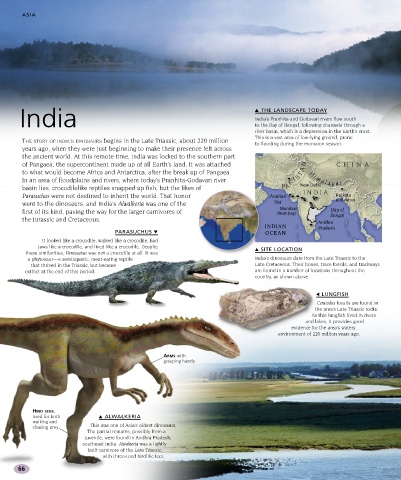
        India                                                                               u the lAndScApe todAy

                                                                                            India’s Pranhita and Godavari rivers flow south
                                                                                            to the Bay of Bengal, following channels through a
                                                                                            river basin, which is a depression in the Earth’s crust.
                                                                                            This is a vast area of low-lying ground, prone
         The sTory of india’s dinosaurs begins in the Late Triassic, about 220 million      to flooding during the monsoon season.
         years ago, when they were just beginning to make their presence felt across
         the ancient world. At this remote time, India was locked to the southern part
         of Pangaea, the supercontinent made up of all Earth’s land. It was attached                          N          C H I N A
         to what would become Africa and Antarctica, after the break up of Pangaea.                          A
         In an area of floodplains and rivers, where today’s Pranhita-Godavari river                     K I S  T H i m a l a y a s
         basin lies, crocodilelike reptiles snapped up fish, but the likes of                        P A    New Delhi
         Parasuchus were not destined to inherit the world. That honor                           Arabian     I N D I A   Kolkata
                                                                                                                         (Calcutta)
         went to the dinosaurs, and India’s Alwalkeria was one of the                              Sea
                                                                                                     Mumbai
                                                                                                                       Bay of
         first of its kind, paving the way for the larger carnivores of                             (Bombay)           Bengal
         the Jurassic and Cretaceous.                                                                             Andhra
                                                                                               INDIAN             Pradesh
                                          pArASUchUS d                                          OCEAN
                It looked like a crocodile, walked like a crocodile, had
               jaws like a crocodile, and lived like a crocodile. Despite                   u SIte locAtIon
          these similarities, Parasuchus was not a crocodile at all. It was
           a phytosaur—a semiaquatic, meat-eating reptile                                   India’s dinosaurs date from the Late Triassic to the
            that thrived in the Triassic, but became                                        Late Cretaceous. Their bones, trace fossils, and trackways
          extinct at the end of this period.                                                are found in a number of locations throughout the
                                                                                            country, as shown above.


                                                                                                                  , lUngfISh
                                                                                                                  Ceratodus fossils are found in
                                                                                                                 the area’s Late Triassic rocks.
                                                                                                                As this lungfish lived in rivers
                                                                                                              and lakes, it provides good
                                                                                                         evidence for the area’s watery
                                                                                                    environment of 220 million years ago.


                                                           Arms with
                                                           grasping hands


             Hind legs,
             used for both          u AlwAlkerIA
             walking and
             chasing prey        This was one of Asia’s oldest dinosaurs.
                                The partial remains, possibly from a
                               juvenile, were found in Andhra Pradesh,
                              southeast India. Alwalkeria was a lightly
                                built carnivore of the Late Triassic,
                                      with three-toed birdlike feet.
       66

