


Page 61 - DINOSOUR ATLAS
P. 61
africa
        Bahariya Oasis                                                                           E     G      Y     P     T   El Faiyûm


         Egypt’s modErn landscapE is a sandy desert through which flows the Nile River.
         It hasn’t always been like this. In the Late Cretaceous, this part of North Africa               Bawin   El Harra
         was a coastal zone bordering the ancient Tethys Sea. Around 95 million years                        Bahariya                 Nile River
         ago the area was a swampland of shallow tidal marshes, water                                          Oasis           El Minya
         channels, and tropical forest. This was a good place for turtles,
         crocodiles, and dinosaurs to live. Spinosaurus—a predator on a                                            Western Desert
         scale with Tyrannosaurus rex—caught fish here, and there were                           Farafra
         enough plants to feed Paralititan, a truly massive sauropod.                             Oasis
         The area where these and other dinosaurs have been found                               u site location
         is today’s Bahariya Oasis, an island of trees and farms                               Bahariya Oasis is 180 miles (290 km) southwest
         surrounded by Egypt’s Western Desert.                                                of Cairo. A shallow depression in the desert floor, it
                                                                                            measures 58 miles long by 26 miles wide (94 km by 42 km).


                                                                                                             u eGYPt’s Western Desert
                                                                                                               The Western Desert of Egypt is an
         Sharklike                                                                                           expanse of sand and chalk outcrops,
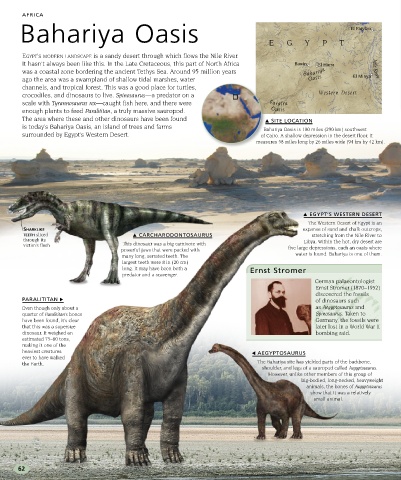
         teeth sliced                           u carcHaroDontosaUrUs                                           stretching from the Nile River to
         through its                                                                                         Libya. Within the hot, dry desert are
         victim’s flesh                      This dinosaur was a big carnivore with                     five large depressions, each an oasis where
                                            powerful jaws that were packed with
                                            many long, serrated teeth. The                                water is found. Bahariya is one of them.
                                             largest teeth were 8 in (20 cm)
                                             long. It may have been both a                ernst stromer
                                             predator and a scavenger.
                                                                                                                 German palaeontologist
                                                                                                                 Ernst Stromer (1870–1952)
                                                                                                                 discovered the fossils
         Paralititan .                                                                                           of dinosaurs such
         Even though only about a                                                                                as Aegyptosaurus and
         quarter of Paralititan’s bones                                                                          Spinosaurus. Taken to
         have been found, it’s clear                                                                             Germany, the fossils were
         that this was a supersize                                                                               later lost in a World War II
         dinosaur. It weighed an                                                                                 bombing raid.
         estimated 75–80 tons,
         making it one of the
         heaviest creatures                                                                , aeGYPtosaUrUs
         ever to have walked
         the Earth.                                                                          The Bahariya site has yielded parts of the backbone,
                                                                                              shoulder, and legs of a sauropod called Aegyptosaurus.
                                                                                                 However, unlike other members of this group of
                                                                                                            big-bodied, long-necked, heavyweight
                                                                                                              animals, the bones of Aegyptosaurus
                                                                                                                show that it was a relatively
                                                                                                                 small animal.


       62

