


Page 11 - Euclid's Elements of Geometry
P. 11
ST	EW      aþ.


                                                                                            ELEMENTS BOOK 1


            τῆς δὲ ΑΒ εὐθείας ἐπὶ τὴν ΔΕ, ἐφαρμόσει καὶ τὸ Β σημεῖον AB on DE, then the point B will also coincide with E,
            ἐπὶ τὸ Ε διὰ τὸ ἴσην εἶναι τὴν ΑΒ τῇ ΔΕ· ἐφαρμοσάσης δὴ  on account of AB being equal to DE. So (because of)
            τῆς ΑΒ ἐπὶ τὴν ΔΕ ἐφαρμόσει καὶ ἡ ΑΓ εὐθεῖα ἐπὶ τὴν ΔΖ  AB coinciding with DE, the straight-line AC will also
            διὰ τὸ ἴσην εἶναι τὴν ὑπὸ ΒΑΓ γωνίαν τῇ ὑπὸ ΕΔΖ· ὥστε καὶ coincide with DF, on account of the angle BAC being
            τὸ Γ σημεῖον ἐπὶ τὸ Ζ σημεῖον ἐφαρμόσει διὰ τὸ ἴσην πάλιν equal to EDF. So the point C will also coincide with the
            εἶναι τὴν ΑΓ τῇ ΔΖ. ἀλλὰ μὴν καὶ τὸ Β ἐπὶ τὸ Ε ἐφηρμόκει· point F, again on account of AC being equal to DF. But,
            ὥστε βάσις ἡ ΒΓ ἐπὶ βάσιν τὴν ΕΖ ἐφαρμόσει. εἰ γὰρ τοῦ point B certainly also coincided with point E, so that the
            μὲν Β ἐπὶ τὸ Ε ἐφαρμόσαντος τοῦ δὲ Γ ἐπὶ τὸ Ζ ἡ ΒΓ βάσις base BC will coincide with the base EF. For if B coin-
            ἐπὶ τὴν ΕΖ οὐκ ἐφαρμόσει, δύο εὐθεῖαι χωρίον περιέξουσιν· cides with E, and C with F, and the base BC does not
            ὅπερ ἐστὶν ἀδύνατον. ἐφαρμόσει ἄρα ἡ ΒΓ βάσις ἐπὶ τὴν coincide with EF, then two straight-lines will encompass
                                                                                                           ‡
            ΕΖ καὶ ἴση αὐτῇ ἔσται· ὥστε καὶ ὅλον τὸ ΑΒΓ τρίγωνον  an area. The very thing is impossible [Post. 1]. Thus,
            ἐπὶ ὅλον τὸ ΔΕΖ τρίγωνον ἐφαρμόσει καὶ ἴσον αὐτῷ ἔσται, the base BC will coincide with EF, and will be equal to
            καὶ αἱ λοιπαὶ γωνίαι ἐπὶ τὰς λοιπὰς γωνίας ἐφαρμόσουσι καὶ it [C.N. 4]. So the whole triangle ABC will coincide with
            ἴσαι αὐταῖς ἔσονται, ἡ μὲν ὑπὸ ΑΒΓ τῇ ὑπὸ ΔΕΖ ἡ δὲ ὑπὸ the whole triangle DEF, and will be equal to it [C.N. 4].
            ΑΓΒ τῇ ὑπὸ ΔΖΕ.                                     And the remaining angles will coincide with the remain-
               ᾿Εὰν ἄρα δύο τρίγωνα τὰς δύο πλευρὰς [ταῖς] δύο  ing angles, and will be equal to them [C.N. 4]. (That is)
            πλευραῖς ἴσας ἔχῃ ἑκατέραν ἑκατέρᾳ καὶ τὴν γωνίαν τῇ  ABC to DEF, and ACB to DFE [C.N. 4].
            γωνίᾳ ἴσην ἔχῃ τὴν ὑπὸ τῶν ἴσων εὐθειῶν περιεχομένην,  Thus, if two triangles have two sides equal to two
            καὶ τὴν βάσιν τῂ βάσει ἴσην ἕξει, καὶ τὸ τρίγωνον τῷ sides, respectively, and have the angle(s) enclosed by the
                                    eþ                          gles. (Which is) the very thing it was required to show.
            τριγώνῳ ἴσον ἔσται, καὶ αἱ λοιπαὶ γωνίαι ταῖς λοιπαῖς equal straight-line equal, then they will also have the base
            γωνίαις ἴσαι ἔσονται ἑκατέρα ἑκατέρᾳ, ὑφ᾿ ἃς αἱ ἴσαι πλευραὶ equal to the base, and the triangle will be equal to the tri-
            ὑποτείνουσιν· ὅπερ ἔδει δεῖξαι.                     angle, and the remaining angles subtended by the equal
                                                                sides will be equal to the corresponding remaining an-


            †  The application of one figure to another should be counted as an additional postulate.
            ‡  Since Post. 1 implicitly assumes that the straight-line joining two given points is unique.


                                      .
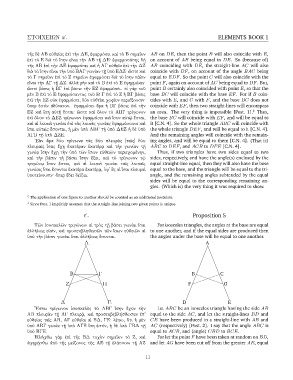
                                                                                  Proposition 5
               Τῶν ἰσοσκελῶν τριγώνων αἱ τρὸς τῇ βάσει γωνίαι ἴσαι  For isosceles triangles, the angles at the base are equal
            ἀλλήλαις εἰσίν, καὶ προσεκβληθεισῶν τῶν ἴσων εὐθειῶν αἱ to one another, and if the equal sides are produced then
            ὑπὸ τὴν βάσιν γωνίαι ἴσαι ἀλλήλαις ἔσονται.         the angles under the base will be equal to one another.
                                    Α                                                  A


                              Β           Γ                                      B           C
                            Ζ               Η                                   F              G


                           ∆                  Ε                              D                  E
               ῎Εστω τρίγωνον ἰσοσκελὲς τὸ ΑΒΓ ἴσην ἔχον τὴν       Let ABC be an isosceles triangle having the side AB
            ΑΒ πλευρὰν τῇ ΑΓ πλευρᾷ, καὶ προσεκβεβλήσθωσαν ἐπ᾿ equal to the side AC, and let the straight-lines BD and
            εὐθείας ταῖς ΑΒ, ΑΓ εὐθεῖαι αἱ ΒΔ, ΓΕ· λέγω, ὅτι ἡ μὲν CE have been produced in a straight-line with AB and
            ὑπὸ ΑΒΓ γωνία τῇ ὑπὸ ΑΓΒ ἴση ἐστίν, ἡ δὲ ὑπὸ ΓΒΔ τῇ  AC (respectively) [Post. 2]. I say that the angle ABC is
            ὑπὸ ΒΓΕ.                                            equal to ACB, and (angle) CBD to BCE.
               Εἰλήφθω γὰρ ἐπὶ τῆς ΒΔ τυχὸν σημεῖον τὸ Ζ, καὶ      For let the point F have been taken at random on BD,
            ἀφῃρήσθω ἀπὸ τῆς μείζονος τῆς ΑΕ τῇ ἐλάσσονι τῇ ΑΖ  and let AG have been cut off from the greater AE, equal

                                                              11

