


Page 13 - Euclid's Elements of Geometry
P. 13
ST	EW      aþ.


                                                                                            ELEMENTS BOOK 1


               Εἰ γὰρ ἄνισός ἐστιν ἡ ΑΒ τῇ ΑΓ, ἡ ἑτέρα αὐτῶν μείζων  For if AB is unequal to AC then one of them is
            ἐστίν. ἔστω μείζων ἡ ΑΒ, καὶ ἀφῃρήσθω ἀπὸ τῆς μείζονος  greater.  Let AB be greater.  And let DB, equal to
            τῆς ΑΒ τῇ ἐλάττονι τῇ ΑΓ ἴση ἡ ΔΒ, καὶ ἐπεζεύχθω ἡ ΔΓ. the lesser AC, have been cut off from the greater AB
               ᾿Επεὶ οὖν ἴση ἐστὶν ἡ ΔΒ τῇ ΑΓ κοινὴ δὲ ἡ ΒΓ, δύο δὴ  [Prop. 1.3]. And let DC have been joined [Post. 1].
            αἱ ΔΒ, ΒΓ δύο ταῖς ΑΓ, ΓΒ ἴσαι εἰσὶν ἑκατέρα ἑκατέρᾳ, καὶ  Therefore, since DB is equal to AC, and BC (is) com-
            γωνία ἡ ὑπὸ ΔΒΓ γωνίᾳ τῇ ὑπὸ ΑΓΒ ἐστιν ἴση· βάσις ἄρα ἡ  mon, the two sides DB, BC are equal to the two sides
            ΔΓ βάσει τῇ ΑΒ ἴση ἐστίν, καὶ τὸ ΔΒΓ τρίγωνον τῷ ΑΓΒ  AC, CB, respectively, and the angle DBC is equal to the
            τριγώνῳ ἴσον ἔσται, τὸ ἔλασσον τῷ μείζονι· ὅπερ ἄτοπον· angle ACB. Thus, the base DC is equal to the base AB,
            οὐκ ἄρα ἄνισός ἐστιν ἡ ΑΒ τῇ ΑΓ· ἴση ἄρα.           and the triangle DBC will be equal to the triangle ACB
               ᾿Εὰν ἄρα τριγώνου αἱ δὑο γωνίαι ἴσαι ἀλλήλαις ὦσιν, καὶ [Prop. 1.4], the lesser to the greater. The very notion (is)
            αἱ ὑπὸ τὰς ἴσας γωνίας ὑποτείνουσαι πλευραὶ ἴσαι ἀλλήλαις absurd [C.N. 5]. Thus, AB is not unequal to AC. Thus,
            ἔσονται· ὅπερ ἔδει δεῖξαι.                          (it is) equal. †
                                    zþ                          equal to one another. (Which is) the very thing it was
                                                                   Thus, if a triangle has two angles equal to one another
                                                                then the sides subtending the equal angles will also be

                                                                required to show.

            †  Here, use is made of the previously unmentioned common notion that if two quantities are not unequal then they must be equal. Later on, use
            is made of the closely related common notion that if two quantities are not greater than or less than one another, respectively, then they must be
            equal to one another.

                                                                                  Proposition 7
                                      .
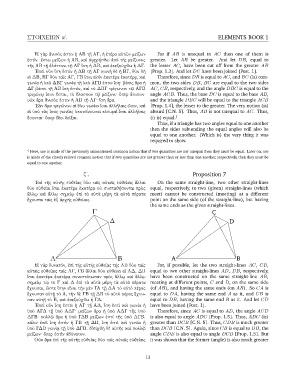
               ᾿Επὶ τῆς αὐτῆς εὐθείας δύο ταῖς αὐταῖς εὐθείαις ἄλλαι  On the same straight-line, two other straight-lines
            δύο εὐθεῖαι ἴσαι ἑκατέρα ἑκατέρᾳ οὐ συσταθήσονται πρὸς  equal, respectively, to two (given) straight-lines (which
            ἄλλῳ καὶ ἄλλῳ σημείῳ ἐπὶ τὰ αὐτὰ μέρη τὰ αὐτὰ πέρατα meet) cannot be constructed (meeting) at a different
            ἔχουσαι ταῖς ἐξ ἀρχῆς εὐθείαις.                     point on the same side (of the straight-line), but having
                                                                the same ends as the given straight-lines.
                                        Γ                                                 C

                                               ∆                                                 D


                      Α                           Β                      A                          B
               Εἰ γὰρ δυνατόν, ἐπὶ τῆς αὐτῆς εὐθείας τῆς ΑΒ δύο ταῖς  For, if possible, let the two straight-lines AC, CB,
            αὐταῖς εὐθείαις ταῖς ΑΓ, ΓΒ ἄλλαι δύο εὐθεῖαι αἱ ΑΔ, ΔΒ  equal to two other straight-lines AD, DB, respectively,
            ἴσαι ἑκατέρα ἑκατέρᾳ συνεστάτωσαν πρὸς ἄλλῳ καὶ ἄλλῳ have been constructed on the same straight-line AB,
            σημείῳ τῷ τε Γ καὶ Δ ἐπὶ τὰ αὐτὰ μέρη τὰ αὐτὰ πέρατα meeting at different points, C and D, on the same side
            ἔχουσαι, ὥστε ἴσην εἶναι τὴν μὲν ΓΑ τῇ ΔΑ τὸ αὐτὸ πέρας (of AB), and having the same ends (on AB). So CA is
            ἔχουσαν αὐτῇ τὸ Α, τὴν δὲ ΓΒ τῇ ΔΒ τὸ αὐτὸ πέρας ἔχου- equal to DA, having the same end A as it, and CB is
            σαν αὐτῇ τὸ Β, καὶ ἐπεζεύχθω ἡ ΓΔ.                  equal to DB, having the same end B as it. And let CD
               ᾿Επεὶ οὖν ἴση ἐστὶν ἡ ΑΓ τῇ ΑΔ, ἴση ἐστὶ καὶ γωνία ἡ  have been joined [Post. 1].
            ὑπὸ ΑΓΔ τῇ ὑπὸ ΑΔΓ· μείζων ἄρα ἡ ὑπὸ ΑΔΓ τῆς ὑπὸ       Therefore, since AC is equal to AD, the angle ACD
            ΔΓΒ· πολλῷ ἄρα ἡ ὑπὸ ΓΔΒ μείζων ἐστί τῆς ὑπὸ ΔΓΒ. is also equal to angle ADC [Prop. 1.5]. Thus, ADC (is)
            πάλιν ἐπεὶ ἴση ἐστὶν ἡ ΓΒ τῇ ΔΒ, ἴση ἐστὶ καὶ γωνία ἡ  greater than DCB [C.N. 5]. Thus, CDB is much greater
            ὑπὸ ΓΔΒ γωνίᾳ τῇ ὑπὸ ΔΓΒ. ἐδείχθη δὲ αὐτῆς καὶ πολλῷ than DCB [C.N. 5]. Again, since CB is equal to DB, the
            μείζων· ὅπερ ἐστὶν ἀδύνατον.                        angle CDB is also equal to angle DCB [Prop. 1.5]. But
               Οὐκ ἄρα ἐπὶ τῆς αὐτῆς εὐθείας δύο ταῖς αὐταῖς εὐθείαις it was shown that the former (angle) is also much greater


                                                              13

