


Page 14 - Euclid's Elements of Geometry
P. 14
ST	EW      aþ.


                                                                                            ELEMENTS BOOK 1

                                    hþ                          (which meet) cannot be constructed (meeting) at a dif-
            ἄλλαι δύο εὐθεῖαι ἴσαι ἑκατέρα ἑκατέρᾳ συσταθήσονται πρὸς  (than the latter). The very thing is impossible.
            ἄλλῳ καὶ ἄλλῳ σημείῳ ἐπὶ τὰ αὐτὰ μέρη τὰ αὐτὰ πέρατα   Thus, on the same straight-line, two other straight-
            ἔχουσαι ταῖς ἐξ ἀρχῆς εὐθείαις· ὅπερ ἔδει δεῖξαι.   lines equal, respectively, to two (given) straight-lines


                                                                ferent point on the same side (of the straight-line), but
                                                                having the same ends as the given straight-lines. (Which
                                                                is) the very thing it was required to show.


                                      .
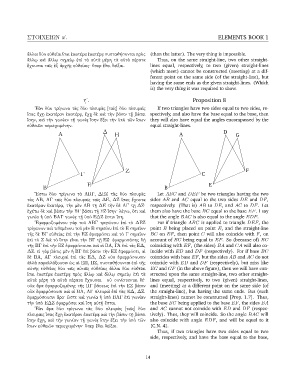
                                                                                  Proposition 8
               ᾿Εὰν δύο τρίγωνα τὰς δύο πλευρὰς [ταῖς] δύο πλευραῖς  If two triangles have two sides equal to two sides, re-
            ἴσας ἔχῃ ἑκατέραν ἑκατέρᾳ, ἔχῃ δὲ καὶ τὴν βάσιν τῇ βάσει spectively, and also have the base equal to the base, then
            ἴσην, καὶ τὴν γωνίαν τῇ γωνίᾳ ἴσην ἕξει τὴν ὑπὸ τῶν ἴσων they will also have equal the angles encompassed by the
            εὐθειῶν περιεχομένην.                               equal straight-lines.
                                            ∆                                                 D
                         Α                       Η                          A                       G


                                                     Ζ                                                  F
                                   Γ                                                 C

                                     Ε                                                  E
                   Β                                                  B
               ῎Εστω δύο τρίγωνα τὰ ΑΒΓ, ΔΕΖ τὰς δύο πλευρὰς       Let ABC and DEF be two triangles having the two
            τὰς ΑΒ, ΑΓ ταῖς δύο πλευραῖς ταῖς ΔΕ, ΔΖ ἴσας ἔχοντα sides AB and AC equal to the two sides DE and DF,
            ἑκατέραν ἑκατέρᾳ, τὴν μὲν ΑΒ τῇ ΔΕ τὴν δὲ ΑΓ τῇ ΔΖ· respectively. (That is) AB to DE, and AC to DF. Let
            ἐχέτω δὲ καὶ βάσιν τὴν ΒΓ βάσει τῇ ΕΖ ἴσην· λέγω, ὅτι καὶ them also have the base BC equal to the base EF. I say
            γωνία ἡ ὑπὸ ΒΑΓ γωνίᾳ τῇ ὑπὸ ΕΔΖ ἐστιν ἴση.         that the angle BAC is also equal to the angle EDF.
               ᾿Εφαρμοζομένου γὰρ τοῦ ΑΒΓ τριγώνου ἐπὶ τὸ ΔΕΖ      For if triangle ABC is applied to triangle DEF, the
            τρίγωνον καὶ τιθεμένου τοῦ μὲν Β σημείου ἐπὶ τὸ Ε σημεῖον point B being placed on point E, and the straight-line
            τῆς δὲ ΒΓ εὐθείας ἐπὶ τὴν ΕΖ ἐφαρμόσει καὶ τὸ Γ σημεῖον BC on EF, then point C will also coincide with F, on
            ἐπὶ τὸ Ζ διὰ τὸ ἴσην εἶναι τὴν ΒΓ τῇ ΕΖ· ἐφαρμοσάσης δὴ  account of BC being equal to EF. So (because of) BC
            τῆς ΒΓ ἐπὶ τὴν ΕΖ ἐφαρμόσουσι καὶ αἱ ΒΑ, ΓΑ ἐπὶ τὰς ΕΔ,  coinciding with EF, (the sides) BA and CA will also co-
            ΔΖ. εἰ γὰρ βάσις μὲν ἡ ΒΓ ἐπὶ βάσιν τὴν ΕΖ ἐφαρμόσει, αἱ incide with ED and DF (respectively). For if base BC
            δὲ ΒΑ, ΑΓ πλευραὶ ἐπὶ τὰς ΕΔ, ΔΖ οὐκ ἐφαρμόσουσιν coincides with base EF, but the sides AB and AC do not
            ἀλλὰ παραλλάξουσιν ὡς αἱ ΕΗ, ΗΖ, συσταθήσονται ἐπὶ τῆς coincide with ED and DF (respectively), but miss like
            αὐτῆς εὐθείας δύο ταῖς αὐταῖς εὐθείαις ἄλλαι δύο εὐθεῖαι EG and GF (in the above figure), then we will have con-
            ἴσαι ἑκατέρα ἑκατέρᾳ πρὸς ἄλλῳ καὶ ἄλλῳ σημείῳ ἐπὶ τὰ  structed upon the same straight-line, two other straight-
            αὐτὰ μέρη τὰ αὐτὰ πέρατα ἔχουσαι. οὐ συνίστανται δέ· lines equal, respectively, to two (given) straight-lines,
            οὐκ ἄρα ἐφαρμοζομένης τῆς ΒΓ βάσεως ἐπὶ τὴν ΕΖ βάσιν and (meeting) at a different point on the same side (of
            οὐκ ἐφαρμόσουσι καὶ αἱ ΒΑ, ΑΓ πλευραὶ ἐπὶ τὰς ΕΔ, ΔΖ. the straight-line), but having the same ends. But (such
            ἐφαρμόσουσιν ἄρα· ὥστε καὶ γωνία ἡ ὑπὸ ΒΑΓ ἐπὶ γωνίαν straight-lines) cannot be constructed [Prop. 1.7]. Thus,
            τὴν ὑπὸ ΕΔΖ ἐφαρμόσει καὶ ἴση αὐτῇ ἔσται.           the base BC being applied to the base EF, the sides BA
               ᾿Εὰν ἄρα δύο τρίγωνα τὰς δύο πλευρὰς [ταῖς] δύο  and AC cannot not coincide with ED and DF (respec-
            πλευραῖς ἴσας ἔχῃ ἑκατέραν ἑκατέρᾳ καὶ τὴν βάσιν τῇ βάσει tively). Thus, they will coincide. So the angle BAC will
            ἴσην ἔχῃ, καὶ τὴν γωνίαν τῇ γωνίᾳ ἴσην ἕξει τὴν ὑπὸ τῶν  also coincide with angle EDF, and will be equal to it
            ἴσων εὐθειῶν περιεχομένην· ὅπερ ἔδει δεῖξαι.        [C.N. 4].
                                                                   Thus, if two triangles have two sides equal to two
                                                                side, respectively, and have the base equal to the base,


                                                              14

