


Page 132 - Euclid's Elements of Geometry
P. 132
ST	EW      eþ.


                                                                                            ELEMENTS BOOK 5


            πάντα τῶν πάντων.                                   times as one of the (first) magnitudes is (divisible) by
                                                                one (of the second), so many times will all (of the first
                                                                magnitudes) also (be divisible) by all (of the second).
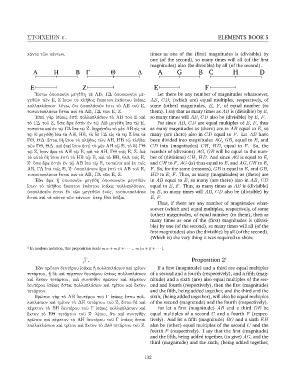
               Α        Η        Β Γ           Θ           ∆       A       G        B C           H           D


              Ε                    Ζ                             E                     F
               ῎Εστω ὁποσαοῦν μεγέθη τὰ ΑΒ, ΓΔ ὁποσωνοῦν με-       Let there be any number of magnitudes whatsoever,
            γεθῶν τῶν Ε, Ζ ἴσων τὸ πλῆθος ἕκαστον ἑκάστου ἰσάκις AB, CD, (which are) equal multiples, respectively, of
            πολλαπλάσιον· λέγω, ὅτι ὁσαπλάσιόν ἐστι τὸ ΑΒ τοῦ Ε,  some (other) magnitudes, E, F, of equal number (to
            τοσαυταπλάσια ἔσται καὶ τὰ ΑΒ, ΓΔ τῶν Ε, Ζ.         them). I say that as many times as AB is (divisible) by E,
               ᾿Επεὶ γὰρ ἰσάκις ἐστὶ πολλαπλάσιον τὸ ΑΒ τοῦ Ε καὶ so many times will AB, CD also be (divisible) by E, F.
            τὸ ΓΔ τοῦ Ζ, ὅσα ἄρα ἐστὶν ἐν τῷ ΑΒ μεγέθη ἴσα τῷ Ε,   For since AB, CD are equal multiples of E, F, thus
            τοσαῦτα καὶ ἐν τῷ ΓΔ ἴσα τῷ Ζ. διῃρήσθω τὸ μὲν ΑΒ εἰς τὰ  as many magnitudes as (there) are in AB equal to E, so
            τῷ Ε μεγέθη ἴσα τὰ ΑΗ, ΗΒ, τὸ δὲ ΓΔ εἰς τὰ τῷ Ζ ἴσα τὰ  many (are there) also in CD equal to F. Let AB have
            ΓΘ, ΘΔ· ἔσται δὴ ἴσον τὸ πλῆθος τῶν ΑΗ, ΗΒ τῷ πλήθει been divided into magnitudes AG, GB, equal to E, and
            τῶν ΓΘ, ΘΔ. καὶ ἐπεὶ ἴσον ἐστὶ τὸ μὲν ΑΗ τῷ Ε, τὸ δὲ ΓΘ CD into (magnitudes) CH, HD, equal to F. So, the
            τῷ Ζ, ἴσον ἄρα τὸ ΑΗ τῷ Ε, καὶ τὰ ΑΗ, ΓΘ τοῖς Ε, Ζ. διὰ number of (divisions) AG, GB will be equal to the num-
            τὰ αὐτὰ δὴ ἴσον ἐστὶ τὸ ΗΒ τῷ Ε, καὶ τὰ ΗΒ, ΘΔ τοῖς Ε,  ber of (divisions) CH, HD. And since AG is equal to E,
            Ζ· ὅσα ἄρα ἐστὶν ἐν τῷ ΑΒ ἴσα τῷ Ε, τοσαῦτα καὶ ἐν τοῖς and CH to F, AG (is) thus equal to E, and AG, CH to E,
            ΑΒ, ΓΔ ἴσα τοῖς Ε, Ζ· ὁσαπλάσιον ἄρα ἐστὶ τὸ ΑΒ τοῦ Ε,  F. So, for the same (reasons), GB is equal to E, and GB,
            τοσαυταπλάσια ἔσται καὶ τὰ ΑΒ, ΓΔ τῶν Ε, Ζ.         HD to E, F. Thus, as many (magnitudes) as (there) are
               ᾿Εὰν ἄρα ᾖ ὁποσαοῦν μεγέθη ὁποσωνοῦν μεγεθῶν     in AB equal to E, so many (are there) also in AB, CD
            ἴσων τὸ πλῆθος ἕκαστον ἑκάστου ἰσάκις πολλαπλάσιον, equal to E, F. Thus, as many times as AB is (divisible)
            ὁσαπλάσιόν ἐστιν ἓν τῶν μεγεθῶν ἑνός, τοσαυταπλάσια by E, so many times will AB, CD also be (divisible) by
            ἔσται καὶ τὰ πάντα τῶν πάντων· ὅπερ ἔδει δεῖξαι.    E, F.
                                                                   Thus, if there are any number of magnitudes what-
                                    bþ                          many times as one of the (first) magnitudes is (divisi-
                                                                soever (which are) equal multiples, respectively, of some
                                                                (other) magnitudes, of equal number (to them), then as

                                                                ble) by one (of the second), so many times will all (of the
                                                                first magnitudes) also (be divisible) by all (of the second).
                                                                (Which is) the very thing it was required to show.

            †  In modern notation, this proposition reads m α + m β + · · · = m (α + β + · · · ).

                                                                                               †
                                      .
                                                                                 Proposition 2
               ᾿Εὰν πρῶτον δευτέρου ἰσάκις ᾖ πολλαπλάσιον καὶ τρίτον  If a first (magnitude) and a third are equal multiples
            τετάρτου, ᾖ δὲ καὶ πέμπτον δευτέρου ἰσάκις πολλαπλάσιον of a second and a fourth (respectively), and a fifth (mag-
            καὶ ἕκτον τετάρτου, καὶ συντεθὲν πρῶτον καὶ πέμπτον nitude) and a sixth (are) also equal multiples of the sec-
            δευτέρου ἰσάκις ἔσται πολλαπλάσιον καὶ τρίτον καὶ ἕκτον ond and fourth (respectively), then the first (magnitude)
            τετάρτου.                                           and the fifth, being added together, and the third and the
               Πρῶτον γὰρ τὸ ΑΒ δευτέρου τοῦ Γ ἰσάκις ἔστω πολ- sixth, (being added together), will also be equal multiples
            λαπλάσιον καὶ τρίτον τὸ ΔΕ τετάρτου τοῦ Ζ, ἔστω δὲ καὶ of the second (magnitude) and the fourth (respectively).
            πέμπτον τὸ ΒΗ δευτέρου τοῦ Γ ἰσάκις πολλαπλάσιον καὶ   For let a first (magnitude) AB and a third DE be
            ἕκτον τὸ ΕΘ τετάρτου τοῦ Ζ· λέγω, ὅτι καὶ συντεθὲν equal multiples of a second C and a fourth F (respec-
            πρῶτον καὶ πέμπτον τὸ ΑΗ δευτέρου τοῦ Γ ἰσάκις ἔσται tively). And let a fifth (magnitude) BG and a sixth EH
            πολλαπλάσιον καὶ τρίτον καὶ ἕκτον τὸ ΔΘ τετάρτου τοῦ Ζ. also be (other) equal multiples of the second C and the
                                                                fourth F (respectively). I say that the first (magnitude)
                                                                and the fifth, being added together, (to give) AG, and the
                                                                third (magnitude) and the sixth, (being added together,

                                                             132

