


Page 137 - Euclid's Elements of Geometry
P. 137
ST	EW      eþ.


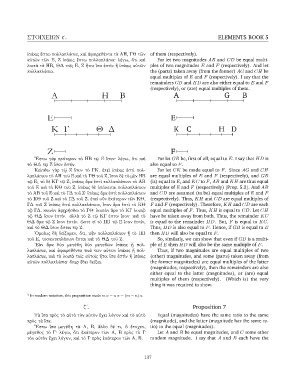
            ἰσάκις ἔστω πολλαπλάσια, καὶ ἀφαιρεθέντα τὰ ΑΗ, ΓΘ τῶν  of them (respectively).  ELEMENTS BOOK 5
            αὐτῶν τῶν Ε, Ζ ἰσάκις ἔστω πολλαπλάσια· λέγω, ὅτι καὶ  For let two magnitudes AB and CD be equal multi-
            λοιπὰ τὰ ΗΒ, ΘΔ τοῖς Ε, Ζ ἤτοι ἴσα ἐστὶν ἢ ἰσάκις αὐτῶν ples of two magnitudes E and F (respectively). And let
            πολλαπλάσια.                                        the (parts) taken away (from the former) AG and CH be
                                                                equal multiples of E and F (respectively). I say that the
                                                                remainders GB and HD are also either equal to E and F
                                                                (respectively), or (are) equal multiples of them.
                       Α                    Η      Β                      A                    G      B


                     Ε                                                   E

                       Κ    Γ            Θ ∆                              K    C            H D


                     Ζ                                                   F
               ῎Εστω γὰρ πρότερον τὸ ΗΒ τῷ Ε ἴσον· λέγω, ὅτι καὶ   For let GB be, first of all, equal to E. I say that HD is
            τὸ ΘΔ τῷ Ζ ἴσον ἐστίν.                              also equal to F.
               Κείσθω γὰρ τῷ Ζ ἴσον τὸ ΓΚ. ἐπεὶ ἰσάκις ἐστὶ πολ-   For let CK be made equal to F. Since AG and CH
            λαπλάσιον τὸ ΑΗ τοῦ Ε καὶ τὸ ΓΘ τοῦ Ζ, ἴσον δὲ τὸ μὲν ΗΒ  are equal multiples of E and F (respectively), and GB
            τῷ Ε, τὸ δὲ ΚΓ τῷ Ζ, ἰσάκις ἄρα ἐστὶ πολλαπλάσιον τὸ ΑΒ  (is) equal to E, and KC to F, AB and KH are thus equal
            τοῦ Ε καὶ τὸ ΚΘ τοῦ Ζ. ἰσάκις δὲ ὑπόκειται πολλαπλάσιον multiples of E and F (respectively) [Prop. 5.2]. And AB
            τὸ ΑΒ τοῦ Ε καὶ τὸ ΓΔ τοῦ Ζ· ἴσάκις ἄρα ἐστὶ πολλαπλάσιον and CD are assumed (to be) equal multiples of E and F
            τὸ ΚΘ τοῦ Ζ καὶ τὸ ΓΔ τοῦ Ζ. ἐπεὶ οὖν ἑκάτερον τῶν ΚΘ, (respectively). Thus, KH and CD are equal multiples of
            ΓΔ τοῦ Ζ ἰσάκις ἐστὶ πολλαπλάσιον, ἴσον ἄρα ἐστὶ τὸ ΚΘ F and F (respectively). Therefore, KH and CD are each
            τῷ ΓΔ. κοινὸν ἀφῃρήσθω τὸ ΓΘ· λοιπὸν ἄρα τὸ ΚΓ λοιπῷ equal multiples of F. Thus, KH is equal to CD. Let CH
            τῷ ΘΔ ἴσον ἐστίν. ἀλλὰ τὸ Ζ τῷ ΚΓ ἐστιν ἴσον· καὶ τὸ  have be taken away from both. Thus, the remainder KC
            ΘΔ ἄρα τῷ Ζ ἴσον ἐστίν. ὥστε εἰ τὸ ΗΒ τῷ Ε ἴσον ἐστίν, is equal to the remainder HD. But, F is equal to KC.
            καὶ τὸ ΘΔ ἴσον ἔσται τῷ Ζ.                          Thus, HD is also equal to F. Hence, if GB is equal to E
               ῾Ομοίως δὴ δείξομεν, ὅτι, κᾂν πολλαπλάσιον ᾖ τὸ ΗΒ  then HD will also be equal to F.
            τοῦ Ε, τοσαυταπλάσιον ἔσται καὶ τὸ ΘΔ τοῦ Ζ.           So, similarly, we can show that even if GB is a multi-
               ᾿Εὰν ἄρα δύο μεγέθη δύο μεγεθῶν ἰσάκις ᾖ πολ- ple of E then HD will also be the same multiple of F.
            λαπλάσια, καὶ ἀφαιρεθέντα τινὰ τῶν αὐτῶν ἰσάκις ᾖ πολ-  Thus, if two magnitudes are equal multiples of two
                                    zþ                          either equal to the latter (magnitudes), or (are) equal
            λαπλάσια, καὶ τὰ λοιπὰ τοῖς αὐτοῖς ἤτοι ἴσα ἐστὶν ἢ ἰσάκις (other) magnitudes, and some (parts) taken away (from
            αὐτῶν πολλαπλάσια· ὅπερ ἔδει δεῖξαι.                the former magnitudes) are equal multiples of the latter
                                                                (magnitudes, respectively), then the remainders are also

                                                                multiples of them (respectively). (Which is) the very
                                                                thing it was required to show.
            †  In modern notation, this proposition reads m α − n α = (m − n) α.

                                                                                  Proposition 7
                                      .
               Τὰ ἴσα πρὸς τὸ αὐτὸ τὸν αὐτὸν ἔχει λόγον καὶ τὸ αὐτὸ  Equal (magnitudes) have the same ratio to the same
            πρὸς τὰ ἴσα.                                        (magnitude), and the latter (magnitude has the same ra-
               ῎Εστω ἴσα μεγέθη τὰ Α, Β, ἄλλο δέ τι, ὃ ἔτυχεν, tio) to the equal (magnitudes).
            μέγεθος τὸ Γ· λέγω, ὅτι ἑκάτερον τῶν Α, Β πρὸς τὸ Γ    Let A and B be equal magnitudes, and C some other
            τὸν αὐτὸν ἔχει λόγον, καὶ τὸ Γ πρὸς ἑκάτερον τῶν Α, Β.  random magnitude. I say that A and B each have the


                                                             137

