


Page 134 - Euclid's Elements of Geometry
P. 134
ST	EW      eþ.


                                                                                            ELEMENTS BOOK 5


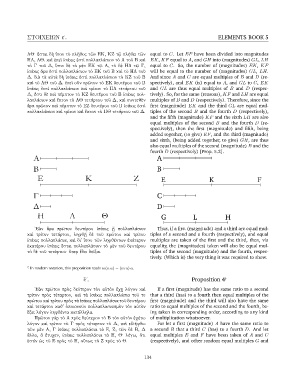
            ΛΘ· ἔσται δὴ ἴσον τὸ πλῆθος τῶν ΕΚ, ΚΖ τῷ πλήθει τῶν  equal to C. Let EF have been divided into magnitudes
            ΗΛ, ΛΘ. καὶ ἐπεὶ ἰσάκις ἐστὶ πολλαπλάσιον τὸ Α τοῦ Β καὶ EK, KF equal to A, and GH into (magnitudes) GL, LH
            τὸ Γ τοῦ Δ, ἴσον δὲ τὸ μὲν ΕΚ τῷ Α, τὸ δὲ ΗΛ τῷ Γ, equal to C. So, the number of (magnitudes) EK, KF
            ἰσάκις ἄρα ἐστὶ πολλαπλάσιον τὸ ΕΚ τοῦ Β καὶ τὸ ΗΛ τοῦ will be equal to the number of (magnitudes) GL, LH.
            Δ. διὰ τὰ αὐτὰ δὴ ἰσάκις ἐστὶ πολλαπλάσιον τὸ ΚΖ τοῦ Β  And since A and C are equal multiples of B and D (re-
            καὶ τὸ ΛΘ τοῦ Δ. ἐπεὶ οὖν πρῶτον τὸ ΕΚ δευτέρου τοῦ Β  spectively), and EK (is) equal to A, and GL to C, EK
            ἴσάκις ἐστὶ πολλαπλάσιον καὶ τρίτον τὸ ΗΛ τετάρτου τοῦ and GL are thus equal multiples of B and D (respec-
            Δ, ἔστι δὲ καὶ πέμπτον τὸ ΚΖ δευτέρου τοῦ Β ἰσάκις πολ- tively). So, for the same (reasons), KF and LH are equal
            λαπλάσιον καὶ ἕκτον τὸ ΛΘ τετάρτου τοῦ Δ, καὶ συντεθὲν multiples of B and D (respectively). Therefore, since the
            ἄρα πρῶτον καὶ πέμπτον τὸ ΕΖ δευτέρου τοῦ Β ἰσάκις ἐστὶ  first (magnitude) EK and the third GL are equal mul-
            πολλαπλάσιον καὶ τρίτον καὶ ἕκτον τὸ ΗΘ τετάρτου τοῦ Δ. tiples of the second B and the fourth D (respectively),
                                                                and the fifth (magnitude) KF and the sixth LH are also
                                                                equal multiples of the second B and the fourth D (re-
                                                                spectively), then the first (magnitude) and fifth, being
                                                                added together, (to give) EF, and the third (magnitude)
                                                                and sixth, (being added together, to give) GH, are thus
                                                                also equal multiples of the second (magnitude) B and the
                                                                fourth D (respectively) [Prop. 5.2].
               Α                                                   A

               Β                                                   B

                 Ε                   Κ                   Ζ          E                   K                    F


               Γ                                                   C

               ∆                                                   D

                 Η            Λ            Θ                        G             L            H
                                    dþ                          tively. (Which is) the very thing it was required to show.
               ᾿Εὰν ἄρα πρῶτον δευτέρου ἰσάκις ᾖ πολλαπλάσιον      Thus, if a first (magnitude) and a third are equal mul-
            καὶ τρίτον τετάρτου, ληφθῇ δὲ τοῦ πρώτου καὶ τρίτου tiples of a second and a fourth (respectively), and equal
            ἰσάκις πολλαπλάσια, καὶ δι᾿ ἴσου τῶν ληφθέντων ἑκάτερον multiples are taken of the first and the third, then, via
            ἑκατέρου ἰσάκις ἔσται πολλαπλάσιον τὸ μὲν τοῦ δευτέρου equality, the (magnitudes) taken will also be equal mul-
            τὸ δὲ τοῦ τετάρτου· ὅπερ ἔδει δεῖξαι.               tiples of the second (magnitude) and the fourth, respec-


            †  In modern notation, this proposition reads m(n α) = (m n) α.

                                      .
                                                                                 Proposition 4
                                                                                               †
               ᾿Εὰν πρῶτον πρὸς δεύτερον τὸν αὐτὸν ἔχῃ λόγον καὶ   If a first (magnitude) has the same ratio to a second
            τρίτον πρὸς τέταρτον, καὶ τὰ ἰσάκις πολλαπλάσια τοῦ τε  that a third (has) to a fourth then equal multiples of the
            πρώτου καὶ τρίτου πρὸς τὰ ἰσάκις πολλαπλάσια τοῦ δευτέρου first (magnitude) and the third will also have the same
            καὶ τετάρτου καθ᾿ ὁποιονοῦν πολλαπλασιασμὸν τὸν αὐτὸν ratio to equal multiples of the second and the fourth, be-
            ἕξει λόγον ληφθέντα κατάλληλα.                      ing taken in corresponding order, according to any kind
               Πρῶτον γὰρ τὸ Α πρὸς δεύτερον τὸ Β τὸν αὐτὸν ἐχέτω of multiplication whatsoever.
            λόγον καὶ τρίτον τὸ Γ πρὸς τέταρτον τὸ Δ, καὶ εἰλήφθω  For let a first (magnitude) A have the same ratio to
            τῶν μὲν Α, Γ ἰσάκις πολλαπλάσια τὰ Ε, Ζ, τῶν δὲ Β, Δ a second B that a third C (has) to a fourth D. And let
            ἄλλα, ἃ ἔτυχεν, ἰσάκις πολλαπλάσια τὰ Η, Θ· λέγω, ὅτι  equal multiples E and F have been taken of A and C
            ἐστὶν ὡς τὸ Ε πρὸς τὸ Η, οὕτως τὸ Ζ πρὸς τὸ Θ.      (respectively), and other random equal multiples G and


                                                             134

