


Page 153 - Euclid's Elements of Geometry
P. 153
ST	EW      eþ.


                                                                                            ELEMENTS BOOK 5


            αὐτῶν ἡ ἀναλογία, καὶ δι᾿ ἴσου ἐν τῷ αὐτῷ λόγῳ ἔσται· ὅπερ F (respectively). Thus, as A (is) to C, so D (is) to F
                                   kdþ                          two by two, and (if) their proportion is perturbed, then
            ἔδει δεῖξαι.                                        [Def. 5.5].
                                                                   Thus, if there are three magnitudes, and others of
                                                                equal number to them, (being) in the same ratio taken

                                                                they will also be in the same ratio via equality. (Which is)
                                                                the very thing it was required to show.

            †  In modern notation, this proposition reads that if α : β :: ǫ : ζ and β : γ :: δ : ǫ then α : γ :: δ : ζ.

                                                                                Proposition 24
                                      .
                                                                                                †
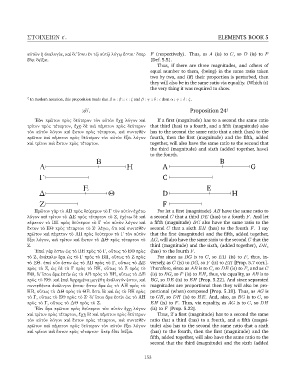
               ᾿Εὰν πρῶτον πρὸς δεύτερον τὸν αὐτὸν ἔχῃ λόγον καὶ   If a first (magnitude) has to a second the same ratio
            τρίτον πρὸς τέταρτον, ἔχῃ δὲ καὶ πέμπτον πρὸς δεύτερον that third (has) to a fourth, and a fifth (magnitude) also
            τὸν αὐτὸν λόγον καὶ ἕκτον πρὸς τέταρτον, καὶ συντεθὲν has to the second the same ratio that a sixth (has) to the
            πρῶτον καὶ πέμπτον πρὸς δεύτερον τὸν αὐτὸν ἕξει λόγον fourth, then the first (magnitude) and the fifth, added
            καὶ τρίτον καὶ ἕκτον πρὸς τέταρτον.                 together, will also have the same ratio to the second that
                                                                the third (magnitude) and sixth (added together, have)
                                                                to the fourth.
                                         Β                                                   B
                 Α                                    Η              A                                    G

                 Γ                                                   C
                                    Ε                                                  E
                 ∆                            Θ                      D                            H
                 Ζ                                                   F
               Πρῶτον γὰρ τὸ ΑΒ πρὸς δεύρερον τὸ Γ τὸν αὐτὸν ἐχέτω  For let a first (magnitude) AB have the same ratio to
            λόγον καὶ τρίτον τὸ ΔΕ πρὸς τέταρτον τὸ Ζ, ἐχέτω δὲ καὶ a second C that a third DE (has) to a fourth F. And let
            πέμπτον τὸ ΒΗ πρὸς δεύτερον τὸ Γ τὸν αὐτὸν λόγον καὶ a fifth (magnitude) BG also have the same ratio to the
            ἕκτον τὸ ΕΘ πρὸς τέταρτον τὸ Ζ· λέγω, ὅτι καὶ συντεθὲν second C that a sixth EH (has) to the fourth F. I say
            πρῶτον καὶ πέμπτον τὸ ΑΗ πρὸς δεύτερον τὸ Γ τὸν αὐτὸν that the first (magnitude) and the fifth, added together,
            ἕξει λόγον, καὶ τρίτον καὶ ἕκτον τὸ ΔΘ πρὸς τέταρτον τὸ  AG, will also have the same ratio to the second C that the
            Ζ.                                                  third (magnitude) and the sixth, (added together), DH,
               ᾿Επεὶ γάρ ἐστιν ὡς τὸ ΒΗ πρὸς τὸ Γ, οὕτως τὸ ΕΘ πρὸς  (has) to the fourth F.
            τὸ Ζ, ἀνάπαλιν ἄρα ὡς τὸ Γ πρὸς τὸ ΒΗ, οὕτως τὸ Ζ πρὸς  For since as BG is to C, so EH (is) to F, thus, in-
            τὸ ΕΘ. ἐπεὶ οὖν ἐστιν ὡς τὸ ΑΒ πρὸς τὸ Γ, οὕτως τὸ ΔΕ  versely, as C (is) to BG, so F (is) to EH [Prop. 5.7 corr.].
            πρὸς τὸ Ζ, ὡς δὲ τὸ Γ πρὸς τὸ ΒΗ, οὕτως τὸ Ζ πρὸς τὸ  Therefore, since as AB is to C, so DE (is) to F, and as C
            ΕΘ, δι᾿ ἴσου ἄρα ἐστὶν ὡς τὸ ΑΒ πρὸς τὸ ΒΗ, οὕτως τὸ ΔΕ  (is) to BG, so F (is) to EH, thus, via equality, as AB is to
            πρὸς τὸ ΕΘ. καὶ ἐπεὶ διῃρημένα μεγέθη ἀνάλογόν ἐστιν, καὶ BG, so DE (is) to EH [Prop. 5.22]. And since separated
            συντεθέντα ἀνάλογον ἔσται· ἔστιν ἄρα ὡς τὸ ΑΗ πρὸς τὸ  magnitudes are proportional then they will also be pro-
            ΗΒ, οὕτως τὸ ΔΘ πρὸς τὸ ΘΕ. ἔστι δὲ καὶ ὡς τὸ ΒΗ πρὸς  portional (when) composed [Prop. 5.18]. Thus, as AG is
            τὸ Γ, οὕτως τὸ ΕΘ πρὸς τὸ Ζ· δι᾿ ἴσου ἄρα ἐστὶν ὡς τὸ ΑΗ  to GB, so DH (is) to HE. And, also, as BG is to C, so
            πρὸς τὸ Γ, οὕτως τὸ ΔΘ πρὸς τὸ Ζ.                   EH (is) to F. Thus, via equality, as AG is to C, so DH
               ᾿Εὰν ἄρα πρῶτον πρὸς δεύτερον τὸν αὐτὸν ἔχῃ λόγον (is) to F [Prop. 5.22].
            καὶ τρίτον πρὸς τέταρτον, ἔχῃ δὲ καὶ πέμπτον πρὸς δεύτερον  Thus, if a first (magnitude) has to a second the same
            τὸν αὐτὸν λόγον καὶ ἕκτον πρὸς τέταρτον, καὶ συντεθὲν ratio that a third (has) to a fourth, and a fifth (magni-
            πρῶτον καὶ πέμπτον πρὸς δεύτερον τὸν αὐτὸν ἕξει λόγον tude) also has to the second the same ratio that a sixth
            καὶ τρίτον καὶ ἕκτον πρὸς τέταρτον· ὅπερ ἔδει δεὶξαι.  (has) to the fourth, then the first (magnitude) and the
                                                                fifth, added together, will also have the same ratio to the
                                                                second that the third (magnitude) and the sixth (added

                                                             153

