


Page 150 - Euclid's Elements of Geometry
P. 150
ST	EW      eþ.


                                                                                            ELEMENTS BOOK 5


            ἔλαττον, ἔλαττον.                                   nitudes) having a ratio to the same (magnitude), that
               ᾿Εὰν ἄρα ᾖ τρία μεγέθη καὶ ἄλλα αὐτοῖς ἴσα τὸ πλῆθος, having the greater ratio is greater [Prop. 5.10]. Thus,
            σύνδυο λαμβανόμενα καὶ ἐν τῷ αὐτῷ λόγω, δι᾿ ἴσου δὲ τὸ  D (is) greater than F. Similarly, we can show that even if
            πρῶτον τοῦ τρίτου μεῖζον ᾖ, καὶ τὸ τέταρτον τοῦ ἕκτου A is equal to C then D will also be equal to F, and even
            μεῖζον ἔσται, κἂν ἴσον, ἴσον, κἂν ἔλαττον, ἔλαττον· ὅπερ if (A is) less (than C then D will also be) less (than F).
            ἔδει δεῖξαι.                                           Thus, if there are three magnitudes, and others of
                                                                equal number to them, (being) also in the same ratio
                                                                taken two by two, and (if), via equality, the first is greater
                                   kaþ                          fourth will also be) equal (to the sixth). And (if the first
                                                                than the third, then the fourth will also be greater than
                                                                the sixth. And if (the first is) equal (to the third then the

                                                                is) less (than the third then the fourth will also be) less
                                                                (than the sixth). (Which is) the very thing it was required
                                                                to show.

            †  In modern notation, this proposition reads that if α : β :: δ : ǫ and β : γ :: ǫ : ζ then α T γ as δ T ζ.

                                      .
                                                                                                †
                                                                                Proposition 21
               ᾿Εὰν ᾖ τρία μεγέθη καὶ ἄλλα αὐτοῖς ἴσα τὸ πλῆθος    If there are three magnitudes, and others of equal
            σύνδυο λαμβανόμενα καὶ ἐν τῷ αὐτῷ λόγῳ, ᾖ δὲ τετα- number to them, (being) also in the same ratio taken two
            ραγμένη αὐτῶν ἡ ἀναλογία, δι᾿ ἴσου δὲ τὸ πρῶτον τοῦ by two, and (if) their proportion (is) perturbed, and (if),
            τρίτου μεῖζον ᾖ, καὶ τὸ τέταρτον τοῦ ἕκτου μεῖζον ἔσται, via equality, the first is greater than the third then the
            κἂν ἴσον, ἴσον, κἂν ἔλαττον, ἔλαττον.               fourth will also be greater than the sixth. And if (the first
                                                                is) equal (to the third then the fourth will also be) equal
                                                                (to the sixth). And if (the first is) less (than the third then
                                                                the fourth will also be) less (than the sixth).
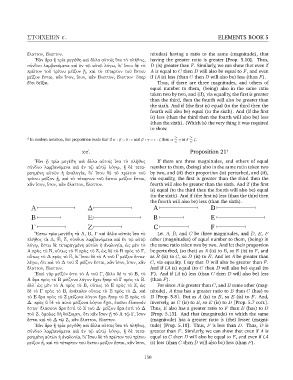
              Α                       ∆                          A                       D
              Β                       Ε                          B                       E
              Γ                       Ζ                          C                       F
               ῎Εστω τρία μεγέθη τὰ Α, Β, Γ καὶ ἄλλα αὐτοῖς ἴσα τὸ  Let A, B, and C be three magnitudes, and D, E, F
            πλῆθος τὰ Δ, Ε, Ζ, σύνδυο λαμβανόμενα καὶ ἐν τῷ αὐτῷ other (magnitudes) of equal number to them, (being) in
            λόγῳ, ἔστω δὲ τεταραγμένη αὐτῶν ἡ ἀναλογία, ὡς μὲν τὸ  the same ratio taken two by two. And let their proportion
            Α πρὸς τὸ Β, οὕτως τὸ Ε πρὸς τὸ Ζ, ὡς δὲ τὸ Β πρὸς τὸ Γ, be perturbed, (so that) as A (is) to B, so E (is) to F, and
            οὕτως τὸ Δ πρὸς τὸ Ε, δι᾿ ἴσου δὲ τὸ Α τοῦ Γ μεῖζον ἔστω· as B (is) to C, so D (is) to E. And let A be greater than
            λέγω, ὅτι καὶ τὸ Δ τοῦ Ζ μεῖζον ἔσται, κἂν ἴσον, ἴσον, κἂν C, via equality. I say that D will also be greater than F.
            ἒλαττον, ἒλαττον.                                   And if (A is) equal (to C then D will also be) equal (to
               ᾿Επεὶ γὰρ μεῖζόν ἐστι τὸ Α τοῦ Γ, ἄλλο δέ τι τὸ Β, τὸ  F). And if (A is) less (than C then D will also be) less
            Α ἄρα πρὸς τὸ Β μείζονα λόγον ἔχει ἤπερ τὸ Γ πρὸς τὸ Β. (than F).
            ἀλλ᾿ ὡς μὲν τὸ Α πρὸς τὸ Β, οὕτως τὸ Ε πρὸς τὸ Ζ, ὡς   For since A is greater than C, and B some other (mag-
            δὲ τὸ Γ πρὸς τὸ Β, ἀνάπαλιν οὕτως τὸ Ε πρὸς τὸ Δ. καὶ nitude), A thus has a greater ratio to B than C (has) to
            τὸ Ε ἄρα πρὸς τὸ Ζ μείζονα λόγον ἔχει ἤπερ τὸ Ε πρὸς τὸ  B [Prop. 5.8]. But as A (is) to B, so E (is) to F. And,
            Δ. πρὸς ὃ δὲ τὸ αὐτὸ μείζονα λόγον ἔχει, ἐκεῖνο ἔλασσόν inversely, as C (is) to B, so E (is) to D [Prop. 5.7 corr.].
            ἐστιν· ἔλασσον ἄρα ἐστὶ τὸ Ζ τοῦ Δ· μεῖζον ἄρα ἐστὶ τὸ Δ Thus, E also has a greater ratio to F than E (has) to D
            τοῦ Ζ. ὁμοίως δὴ δείξομεν, ὅτι κἂν ἴσον ᾖ τὸ Α τῷ Γ, ἴσον [Prop. 5.13]. And that (magnitude) to which the same
            ἔσται καὶ τὸ Δ τῷ Ζ, κἂν ἔλαττον, ἔλαττον.          (magnitude) has a greater ratio is (the) lesser (magni-
               ᾿Εὰν ἄρα ᾖ τρία μεγέθη καὶ ἄλλα αὐτοῖς ἴσα τὸ πλῆθος, tude) [Prop. 5.10]. Thus, F is less than D. Thus, D is
            σύνδυο λαμβανόμενα καὶ ἐν τῷ αὐτῷ λόγῳ, ᾖ δὲ τετα- greater than F. Similarly, we can show that even if A is
            ραγμένη αὐτῶν ἡ ἀναλογία, δι᾿ ἴσου δὲ τὸ πρῶτον τοῦ τρίτου equal to C then D will also be equal to F, and even if (A
            μεῖζον ᾖ, καὶ τὸ τέταρτον τοῦ ἕκτου μεῖζον ἔσται, κἂν ἴσον, is) less (than C then D will also be) less (than F).

                                                             150

