


Page 154 - Euclid's Elements of Geometry
P. 154
ST	EW      eþ.


                                   keþ                          together, have) to the fourth. (Which is) the very thing it
                                                                                            ELEMENTS BOOK 5


                                                                was required to show.

            †  In modern notation, this proposition reads that if α : β :: γ : δ and ǫ : β :: ζ : δ then α + ǫ : β :: γ + ζ : δ.

                                                                                                †
                                                                                Proposition 25
                                      .
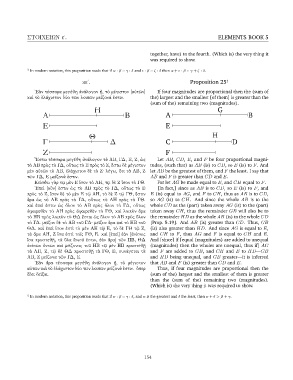
               ᾿Εὰν τέσσαρα μεγέθη ἀνάλογον ᾖ, τὸ μέγιστον [αὐτῶν]  If four magnitudes are proportional then the (sum of
            καὶ τὸ ἐλάχιστον δύο τῶν λοιπῶν μείζονά ἐστιν.      the) largest and the smallest [of them] is greater than the
                                                                (sum of the) remaining two (magnitudes).
                                        Η                                                   G
                   Α                                 Β                A                                  B

                   Ε                                                  E

                                      Θ                                                   H
                   Γ                           ∆                      C                           D

                   Ζ                                                  F
               ῎Εστω τέσσαρα μεγέθη ἀνάλογον τὰ ΑΒ, ΓΔ, Ε, Ζ, ὡς   Let AB, CD, E, and F be four proportional magni-
            τὸ ΑΒ πρὸς τὸ ΓΔ, οὕτως τὸ Ε πρὸς τὸ Ζ, ἔστω δὲ μέγιστον tudes, (such that) as AB (is) to CD, so E (is) to F. And
            μὲν αὐτῶν τὸ ΑΒ, ἐλάχιστον δὲ τὸ Ζ· λέγω, ὅτι τὰ ΑΒ, Ζ  let AB be the greatest of them, and F the least. I say that
            τῶν ΓΔ, Ε μείζονά ἐστιν.                            AB and F is greater than CD and E.
               Κείσθω γὰρ τῷ μὲν Ε ἴσον τὸ ΑΗ, τῷ δὲ Ζ ἴσον τὸ ΓΘ.  For let AG be made equal to E, and CH equal to F.
               ᾿Επεὶ [οὖν] ἐστιν ὡς τὸ ΑΒ πρὸς τὸ ΓΔ, οὕτως τὸ Ε   [In fact,] since as AB is to CD, so E (is) to F, and
            πρὸς τὸ Ζ, ἴσον δὲ τὸ μὲν Ε τῷ ΑΗ, τὸ δὲ Ζ τῷ ΓΘ, ἔστιν E (is) equal to AG, and F to CH, thus as AB is to CD,
            ἄρα ὡς τὸ ΑΒ πρὸς τὸ ΓΔ, οὕτως τὸ ΑΗ πρὸς τὸ ΓΘ. so AG (is) to CH. And since the whole AB is to the
            καὶ ἐπεί ἐστιν ὡς ὅλον τὸ ΑΒ πρὸς ὅλον τὸ ΓΔ, οὕτως whole CD as the (part) taken away AG (is) to the (part)
            ἀφαιρεθὲν τὸ ΑΗ πρὸς ἀφαιρεθὲν τὸ ΓΘ, καὶ λοιπὸν ἄρα taken away CH, thus the remainder GB will also be to
            τὸ ΗΒ πρὸς λοιπὸν τὸ ΘΔ ἔσται ὡς ὅλον τὸ ΑΒ πρὸς ὅλον the remainder HD as the whole AB (is) to the whole CD
            τὸ ΓΔ. μεῖζον δὲ τὸ ΑΒ τοῦ ΓΔ· μεῖζον ἄρα καὶ τὸ ΗΒ τοῦ [Prop. 5.19]. And AB (is) greater than CD. Thus, GB
            ΘΔ. καὶ ἐπεὶ ἴσον ἐστὶ τὸ μὲν ΑΗ τῷ Ε, τὸ δὲ ΓΘ τῷ Ζ, (is) also greater than HD. And since AG is equal to E,
            τὰ ἄρα ΑΗ, Ζ ἴσα ἐστὶ τοῖς ΓΘ, Ε. καὶ [ἐπεὶ] ἐὰν [ἀνίσοις and CH to F, thus AG and F is equal to CH and E.
            ἴσα προστεθῇ, τὰ ὅλα ἄνισά ἐστιν, ἐὰν ἄρα] τῶν ΗΒ, ΘΔ And [since] if [equal (magnitudes) are added to unequal
            ἀνίσων ὄντων καὶ μείζονος τοῦ ΗΒ τῷ μὲν ΗΒ προστεθῇ  (magnitudes) then the wholes are unequal, thus if] AG
            τὰ ΑΗ, Ζ, τῷ δὲ ΘΔ προστεθῇ τὰ ΓΘ, Ε, συνάγεται τὰ  and F are added to GB, and CH and E to HD—GB
            ΑΒ, Ζ μείζονα τῶν ΓΔ, Ε.                            and HD being unequal, and GB greater—it is inferred
               ᾿Εὰν ἄρα τέσσαρα μεγέθη ἀνάλογον ᾖ, τὸ μέγιστον that AB and F (is) greater than CD and E.
            αὐτῶν καὶ τὸ ἐλάχιστον δύο τῶν λοιπῶν μείζονά ἐστιν. ὅπερ  Thus, if four magnitudes are proportional then the
            ἔδει δεῖξαι.                                        (sum of the) largest and the smallest of them is greater
                                                                than the (sum of the) remaining two (magnitudes).
                                                                (Which is) the very thing it was required to show.

            †  In modern notation, this proposition reads that if α : β :: γ : δ, and α is the greatest and δ the least, then α + δ > β + γ.


                                                             154

